Saturday, July 14, 2012

Hegel on Education

From Hegel's Elements of the Philosophy of Right, trans. Nisbett (Cambridge UP, 1991), 196:

"When a father asked him for the best advice about the best way of educating his son in ethical matters, a Pythagorean replied: 'Make him a citizen of a state with good laws.'"

Draw your own analogies.

Thursday, July 12, 2012

The Drama of Belief: Tony Kushner on Theatre

Last spring when I was in New York I had really hoped I could score tickets to Tony Kushner's play, The Intelligent Homosexual's Guide to Capitalism and Socialism, but didn't.  (Most will know Kushner from Angels in America.) Especially for someone like me, who's sympathetic to voices like Ross Douthat and Charles Taylor and John Milbank, it's important to hear a very different sort of critique of our present--the sort of diagnosis of modernity that ripples across Kushner's oeuvre.

The interview with Kushner in the latest issue of The Paris Review only confirmed this sense for me.  It is a conversation sparkling with insight, sounding existential depths.

Indeed, one of the things that struck me is how often Kushner's take on drama echoes Augustine's account of drama (which I've discussed elsewhere)--except that they have very different evaluations of what's at issue.  Consider, for instance, Kushner's reflection on how writing differs from acting:

When I'm writing a new play, there's a period where I know I shouldn't be out in public much. I imagine most people who create go through something like this. You will fully loosen some of the inner straps that hold your core together. You become more porous and multivalent and multivocal, so that the multitudes you have inside yourself can start to get up and walk around and emerge. Then, hopefully, you put them back into the cave.  But to really play Linda Loman, you have to go there every night.  So you live in a state, I would imagine, of permanent looseness in the core, which I find frankly terrifying (pp. 116-117).

That's exactly what terrifies Augustine about the stage in Book III of the Confessions: the actor so regularly divests the self of a center and identify--so regularly fragments and dissipates the self (the chief effect of sin, for Augustine)--that Augustine worries there's no return.  This is the great danger for actors.  And Kushner recognizes the danger. He's not willing to go there himself, but also thinks that actors are those brave souls who have the courage to risk themselves in this way.

But then, interestingly, Kushner unwittingly hits on Augustine's concern for theatre-goers.  Kushner again:

Sometimes a phony-baloney actor will hoodwink the public for decades, but the actors we really rever aren't kidding around when they act. They suffer. PArt of what we are paying to see when we go to the theater is suffering. We want to see actual suffering. There's a certain Christ-like thing going on--the actors are suffering so we don't have to (p. 117).

I'm not interested in the "Christ-figure" bit; I'm intrigued by Kushner's claim about theatre-goers: we don't suffer; we merely observe suffering.  Once again, this is one of Augustine's central concerns in Book III: the play engenders emotion in us, but not real suffering (it's not happening to us), and not sympathy other (we know they're acting). So we go to enjoy suffering (and if you know anything of Augustine's use/enjoyment distinction, you can imagine how perverted he thinks this is.  I'm not saying he's right, just that there are these intriguing parallels with Kushner's take).

This leads Kushner into a nuanced, philosophical discussion of the productive tensions between realism and fantasy on the stage.  Drama, he contends, remains that unique genre where the audience has to be in on the joke--we have to wink in return when we see the director wink at us off-stage, because you can't hide the curtain and you can't not hear the stage crew moving props around and you can't get lost in a totalized fantasy world like you can in the cinema. (Kushner launches into a fascinating critique of our erotic relationship to technology on this point insofar as technology tries to hide its human origins, the fact that it's made.)

Kushner points to one of his key influences on this point:

Brecht says the point of theater is, among other things, to make you conscious of this disappearing trick.  That's why he used a half-curtain in his productions, with the audience watching one scene being played out in front of the curtain and, behind it, the next scene being prepared.  As he wrote in one of his theater poems, let people "see that this is not magic, but work, my friends." His most famous, and most misunderstood, idea about staging is what he calls the distanciation effect--he wants theater to enable you to see the familiar as strange and the strange as familiar, so that you greet reality with an appetite to interpret it (pp. 118-119).  

This is why Kushner thinks drama can have such a critical function in society, without devolving into mere tracts and propoganda.  It gets us to question our reality.  "The incomplete, imperfect illusion will never be unnecessary for human beings," he concludes, "and its home will always be in the theater, where everything, including death, is simultaneously thoroughly and yet not entirely convincing."


Friday, July 06, 2012

"The Devil Has All the Best Stories": JKAS on ABC's "Encounter"

While I was in Australia I was interviewed by David Rutledge for "Encounter," a program on ABC's Radio National (think of it as the Australian equivalent of the BBC).  Rutledge was engaged and curious, so the interview was really just a ranging conversation.

They've now edited that interview, along with snippets from my New College Lectures, to produce the 1-hour program of Encounter for July 7.  However, you can already listen to the program, "The Devil Has All the Best Stories," online.

I'm not sure that the in-person, informal, conversational mode of my presentation necessarily translates into "good radio," but you'll find the program offers a preview of my new book, Imagining the Kingdom: How Worship Works (appearing in January 2013).


Wednesday, June 20, 2012

The Colossian Forum Blog

The Colossian Forum is launching a new blog that should get some more energy in the coming months thanks to their recruitment of Matt Dodrill as a Junior Fellow.

Truth in advertising: Matt is one of my former students, just graduated from Calvin College, and is now headed to Duke Divinity School.  One of the rare students at Calvin from south of the Mason-Dixon line, Matt has been one of the bright lights for us over the past few years--part of a crew of bright students working at the intersection of philosophy and theology.  We'll miss him, but I'm glad to see he'll be involved in the work of The Colossian Forum.  (To learn more about Matt and other folks involved with TCF, visit Faces of the Forum.)

In fact, Matt's first post is a nice encapsulation of the mission and vision of TCF--an invitation to a new kind of conversation.  (And despite the title, you'll quickly see that this is not a covert emergent/McLaren project: the "new" conversation is actually an invitation into a "old" conversation which is the Chalcedonian tradition.  

Check it out.

Tuesday, June 19, 2012

Tradition FOR Innovation

The good folks at Duke's "Faith and Leadership" magazine have just posted an article they invited me to write on the dynamic interplay between tradition and innovation.  A snippet from the conclusion of my talk at the 2012 Q conference, the article focuses on how and why liturgical tradition can foster cultural innovation.  

Read "Tradition for Innovation" at Faith and Leadership.

Monday, June 18, 2012

Picturing "Church" & "State": Crayer's "Benedict receiving Totila"

Last week our family enjoyed an evening at the Art Gallery of Ontario here in Toronto.  (Note to large families: the museum is free on Wednesday's from 6:00-8:30pm.)

Earlier that day I had led a seminar on William Cavanaugh's classic essay, "'A Fire Strong Enough to Consume the House': The Wars of Religion and the Rise of the Nation State."  In this 1995 article, reproduced in the Radical Orthodoxy Reader, Cavanaugh documents that the so-called Wars of Religion were not actually driven by theological and religious difference but rather by the consolidation of nation-states after the demise of feudal arrangements.  While the modern, liberal, democratic stated claims the status of "savior" who delivers us from the violence of religion, in fact it was the rise of the nation-state that engendered these wars.  The state gets to play "rescue hero" fireman because it was also the arsonist.

In the course of the analysis, Cavanaugh debunks the myth of secular neutrality that undergirds the modern state.  The nation-state doesn't deliver us from theology; it delivers us over to a different (covert) theology.  Indeed, in the words of Hobbes, Leviathan doesn't deliver us from the ecclesia; Leviathan swallows the church and functions as a parody of the ecclesia.

How striking, then, to run into this gigantic canvas later that afternoon at AGO:


The work, by Flemish painter Gaspar de Crayer (1584-1669), is entitled "Saint Benedict Receiving Totila, King of the Ostrogoths, 1633."  The huge canvas (it must be 8' x 12') hung in a Benedictine Abbey in Flanders.  It portrays the repentance of Totila for having previously deceived Benedict (by sending a servant dressed in his armor).

It might be easy to think that this painting depicts the inverse of what Cavanaugh notes, namely, the church ruling over the state.  But of course that's not the case: Benedict is not the Holy Roman Emperor, he is an abbot. Totila is being received at an abbey, not submitting to a rival king.  And yet Benedict does not shrink for prophetically denouncing Totila's violent rule.  Retreat into the abbey was not a withdrawal from worldly concern; it is a retreat to contemplative work for the world.  The painting itself depicts what we might call the "porosity" of the abbey.  It also illustrates that the abbot is not indifferent to the shape of worldly rule, even if he might be characterized by a sort of holy ambivalence.

Friday, June 08, 2012

A Photographic Allegory


I absolutely love this Nicholas Nixon photograph from MOMA's collection.  Entitled simply, "Covington, Kentucky," it's a picture you can look at for hours and still feel something new and different.  The composition is exquisite: those horizontal lines and shadows backing the smooth, light skin of innocent childhood in summertime; the young girl looking longingly at his repose; the others glaring at us behind the camera...

But when you look at it alongside the commentary in MOMA Highlights, the art of the photograph can take on a suggestive, almost allegorical vibe that resonates, I think, with the situation of the church in our postmodern age.  Consider this commentary and see if you don't sense a kind of "ancient-future" sensibility that might illustrate postmodern retrievals of ancient, catholic practices.


The taut clapboards zip across the open middle of the picture as if to measure the outward stretch of the boy's arms, while he blissfully tilts his head skyward. A photograph can only describe what the camera sees, but this one also shows how a body can feel. There is something else, which the reproduction cannot fully capture. The print was made from a negative as large as itself—eight by ten inches. To make the negative, Nixon used a big camera on a tripod and put his head under a black cloth to focus the image. All of that old-fashioned effort was worthwhile because the richness of detail in the negative yielded a print that is at once sharp as a pin and smooth as a child's skin and the light that falls upon it.
By the 1970s the artistic traditions of photography were old enough for abandoned styles and techniques to serve as fresh points of departure. After photographers had been in love with the ease and quickness of hand-held cameras for two generations, the cumbersome cameras of the past presented a new challenge. For Nixon, the challenge was to make the old box responsive to unfolding experience: to marry the ancient precision of photography with its modern agility.

Tuesday, May 29, 2012

Scholarship as a Way of Life

[On April 14 I was asked to give a brief opening address to the West Michigan Honors Conference hosted by our own Honors Program here at Calvin College.  The conference was an opportunity for students from several colleges and universities to share the fruits of undergraduate research. These are my notes for the talk which might be of interest to others. (The talk was more conversational, so these points were more developed in the oral version.) I hope this might also address the misguided but persistent impression that somehow my recent work is "anti-intellectual."]


It's a Saturday morning, late in the semester, and you're here for a scholarly conference?  I love you guys!   Welcome to the club of freaks and geeks who pursue scholarship as a way of life.  

I hope that's a club you want to join (granted, there are Woody Allenish worries in the ballpark here).  I hope you're here contributing to the conversation because curiosity gives you an adrenalin rush, because generating new knowledge makes your heart sing.  Because the life of scholarship is not something that should be instrumentalized for other ends; nor should it be reduced to a particular profession; scholarship is a way of life--one I hope you'll pursue in your years ahead even if you never go to grad school or entertain becoming a professor or professional "scholar." 

The scholarly life is its own reward: it is a good life--it is the sort of reflective pursuit that has been valorized by the ancients.  It is also the sort of life that is increasingly difficult to sustain in a sound-bite culture of perpetual distraction.  In the age of the Kardashians and iPhone Twitter feeds, finding joy in the slow-food of scholarly reflection is a counter-cultural pursuit.  

Let me highlight three joys of scholarship as a way of life.

The Joy of Finding: Seeing New Corners of the World

The scholarly life is its own reward: joys of being a perpetual student (cp. my own continued experience of the joy of discovery, e.g., in returning to Jonathan Edwards' Freedom of the Will this past semester; I love teaching what I don't know!).  

Don't let initiation into the guild beat that out of you.  Build habits that will continue to propel you into new arenas in your future.

The Joy of Making: Unpacking the Potential of the World

We might be wrongly tempted to think of scholarship as a very passive way of life: observing, analyzing, describing, criticizing.  But in fact scholarship is a fundamentally creative way of life: it certainly requires us to be attentive and attuned to the world--to texts that are in front of us, to slides under the microscope, to data generated by experiments, etc.  Scholarship makes us accountable to a world.  But if we are really doing scholarship, then we are not just passive consumers of information, nor are we merely passive observers.  By posing questions and confirming hypotheses and arguing with the literature and making an argument, we are making.  We are unfurling more of the potential that is latent in the world, unpacking new possibilities.  Scholarship is a mode of poiesis, of making, creating.  It is a generative way of life.  Good scholarship is not unlike good craftsmanship: there is a special joy in the product of our labor.  

And let's remember: you don't have to be in a lab or a studio or a library to be doing this.  The best entrepreneurs are some of our best scholars.  A scholarly way of life contributes to culture and the common good.

The Joy of Collaborating

You might be tempted to picture scholars holed up in their offices or studios or laboratories, sequestered from the world, hunched over as they work in isolation. But the scholarly way of life is richest and most innovative when it is pursued collaboratively, through "wisdom networks" and in life-giving teams.  Ideas percolate communally.

-Jon Gertner's new book about Bell Labs, The Idea Factory, who shows us that "most sustained feats of innovation cannot and do not occur in an iconic garage or the workshop of an ingenuous inventor.  They occur when people of diverse talents and mind-sets and expertise are brought together, preferable in close physical proximity where they can have frequent meetings and serendipitous encounters" (Isaacson).  This has found expression in recent architecture for research facilities (Per Paul Goldberger's analysis in "Laboratory Conditions," New Yorker, Sept. 19, 2011, pp. 88-89).

This week I've had two wonderful interactions: with Jim Olthuis, my advisor through my master's degree and long-time mentor; and with Nathan Sytsma, a former student who worked as my MacGregor Fellow.  As a scholar, there is a unique joy in being both a "son" and a "father." 

A scholarly way of life is fundamentally collaborative--fostered in a community of friendship.  So remember your mentors and pay your debts: build into the lives of others; contribute to a team; mentor someone, explore and think and create alongside others.

Conclusion

To say that scholarship is a way of life is to emphasize that it is characterized by certain habits--of reflection, exploration, creativity, and collaboration.  These are habits that you have already learned and valued (you're here on a Saturday morning, for goodness sake!).  As move beyond your undergraduate education, resist the siren calls that would lure you away from this way of life.

For some reason, this brings to mind one of my favorite passages from Plato--a passage that called me to the way of life of a scholar:

"This much I ask of them: when my sons grow up, avenge yourselves by causing them thte same kind of grief that I caused you, if you think they care for money or anything else more than they care for virtue, or if they think they are somebody when they are nobody.  Reproach them as I reproach you, that they do not care for the right things and think they are worthy when they are not worthy of anything.  If you do this, I shall have been justly treated by you, and my sons also." -Socrates in Apology, 41e-42a

Wednesday, May 16, 2012

Letter to a Son Who's Graduating

Our church's youth group has a wonderful tradition: as part of a retreat for high school seniors, parents are invited to write a letter to their children that they receive at the retreat (and the kids are invited to write letters to their parents).  It's a wonderful rite of passage that encourages reflection and gratitude and honesty.  The result, as you might imagine, is a lot of tear-stained letters.

Deanna and I just finished our letters to our second-oldest, Coleson.  Deanna's was absolutely gorgeous and moving--I'm still wiping the tears off my desk.

In some ways, writing mine felt like a bit of an appendix to my "Letter to a Young Parent."  I reproduce just a snippet here, only because it's a way to share this wonderful quote and metaphor from Christopher Buckley's memoir of his parents, Losing Mom and Pup.
"We haven't always gotten it right as parents (as I'm sure you'll agree).  But we've always tried our best, and our only goal has been your flourishing. So we've tried to channel you toward a good life--a life well-lived. In Christopher Buckley's memoir of his parents, Losing Mum and Pup, he talks about his father teaching him to sail. "He taught me on that trip how to navigate by the sun and the stars with a sextant. As I look back, it seems to me one of the most fundamental skills a father can teach a son: finding out where you are, using the tools of your ancestors."  Well, I didn't teach you anything as concrete (or bourgeois!) as sailing, but I hope you some day see that we have been trying to help you get your bearings with the faith of our ancestors--Abraham and Isaiah and Paul and Augustine, and above all Jesus, who is both our brother and our North Star. May you always be able to navigate where you are, and who you are, and whose you are."


Tuesday, May 15, 2012

Generational Blackmail?

It seems like every other day I'm told another reason why young people are leaving the church: because Christians fight too much, or because Christians are too political or anti-gay or don't care about social justice.  Millennials, we're told, are leaving the church because the church won't bless their cohabitation or provide them with contraception for pre-marital sex. They're leaving because they don't care about fights over creation/evolution or abortion or worship style or what have you.  In sum, it seems we're regularly informed that if the church doesn't change, young people are going to leave.

And what exactly are we supposed to do with these claims?  I think the upshot is pretty clear.  Indeed, am I the only one who feels like they're a sort of bargaining chip--a kind of emotional blackmail meant to get the church to relax its commitments in order to make the church more acceptable?

Could we entertain the possibility that millennials might be wrong?

Thursday, May 10, 2012

An Engagement with "Two Kingdoms" Thought

In my little corner of Reformed Christianity, there has been a notable uptick in folks who are sympathetic to "two kingdoms" (2K) theologies of culture--a model more traditionally associated with the Lutheran tradition.  There are aspects of 2K thought I appreciate, notably its robust emphasis on the church as a sacramental community as well, its critique of the idolatry of nationalism, and its goal to resist Christian accommodation to partisan politics.  There are other aspects, however, that I'm less enthused about.

I think this is an important conversation and one to which I hope to contribute over the next several years, culminating in volume 3 of my Cultural Liturgies trilogy, which will focus on political theology.  In the meantime, here's a first foray just published: "Reforming Public Theology: Two Kingdoms, or Two Cities?," Calvin Theological Journal 47 (2012): 122-137, reprinted with permission.


"Reforming Public Theology: Two Kingdoms, or Two Cities?," Calvin Theological Journal 47 (...

Monday, May 07, 2012

Confessions, Generations, and the Future of the CRC

Bob De Moor's editorial in the most recent issue of The Banner (the denominational magazine of the Christian Reformed Church) is both symptomatic and wrongheaded.  But given what's at stake in this summer's Synod, perhaps a word or two is in order.

The backstory, for those not previously enthralled by synodical proceedings: our denomination historically requires officers of the church (pastors, elders, and faculty of Calvin College) to sign the Form of Subscription as an expression of commitment to our Three Forms of Unity: the Belgic Confession, the Heidelberg Catechism, and the Canons of Dordt--three historic confessions of the Reformed faith.  Last summer, a committee proposed replacing the Form of Subscription with a much-watered-down "Covenant for Officebearers" which effectively said something like, 'I agree that these confessions were things people used to believe.' (I'm loosely paraphrasing.)  Fortunately, the committee's proposal was defeated at Synod and sent back to committee.

A revised version will come before Synod this summer.  I think it's still a tepid document, but not as bad as what was floated in 2011.  But De Moor has suggested that this tepid version is still too much.  Instead, he says,
We need to make the Contemporary Testimony what we sign on to instead of the historic confessions.
Of course, this is accompanied by the obligatory nod toward the confessions as "historical" documents that should be "honored"--but not, of course, believed.  As you'll see his the editorial, "we" are clearly smarter and too advanced in our knowledge to ever be able to believe these historic confessions.  Anyone who has read Bultmann will be familiar with this kind of move: 'These are really quite remarkable documents, but seriously: who could believe them in an age of electric light?'

I'm going to try to curtail my disdain for this sort of posturing.  Instead, let me say just three things:

(1) De Moor is once again executing plays from the liberal Protestant playbook.  Anyone who is at all familiar with the slide of mainline denominations will recognize this rhetoric and posture.  (I'd love to recruit a student to undertake content analysis of De Moor editorials and then compare them with similar documents from denominational magazines published by the PC(USA), ELCA, and United Methodists in the 60s and 70s.)  Indeed, I would encourage folks from the denomination--and especially synodical delegates--to prepare for Synod by reading Ross Douthat's Bad Religion: How We Became a Nation of Heretics, especially the chapter on "Accommodation" and then pp. 140-141 on the creeping anti-institutionalism that eviscerates thick confessional identity.

(2) While De Moor is pointing out the supposed historical limitations of Reformed confessions forged in the 16th and 17th centuries, in fact nothing in his argument can prevent the same stance and posture toward ancient catholic confessions like Nicea and Chalcedon.  Should we also just tip our hat to those creeds, Bob, but then pledge our allegiance to an activist document written by North Americans in the 80s?

(3) I have a little hypothesis to float here, and I know it will be somewhat off-putting.  But here goes: I think this is very much a generational issue.  More specifically, I think this is a baby boomer problem.  And for the past 20 years, the leadership of our denomination has been in the hands of baby boomers who absorbed an anti-institutionalism that was in the water in the late 60s and early 70s, which they then channeled toward the faith of their forebears--particularly their immigrant forebears.  This gave us the disastrous attempts by the denomination to turn us into bland "community church" evangelicalism.  It also produced the sort of covert Protestant liberalism that De Moor and others regularly tout.

Hey, baby boomers, I want to let you in on a little secret: you don't own the denomination, though I know you've acted like you do for the past 20 years.  And I know you think that the next generation is looking to eviscerate our confessional Reformed particularity just as you've been trying to do.  But it's a lot more complicated than that.  In fact, I think you should start to realize that those opposing you are not just "old codgers" who aren't as enlightened as you, but also younger folks who have seen where this goes and are actually looking for a more ancient faith.  Some of us Gen Xers and rising millennials are not interested in your "updated" faith: we're looking for the thick, rich particularity of historic Reformed faith, understood as an expression of catholic Christianity.

(If you want just a little confirmation of this, let me ask: have you ever heard of this guy Tim Keller?  Who ministers in Manhattan? [And that's Manhattan, NY, not Manhattan, MT.] Whose network of unapologetically Reformed churches have been growing in one of the most secularized regions of the country?)

I don't want to turn this into a generation-war.  But I do want our baby boomer leaders to know that we're here, that we're invested, and that we're not going away.  So get used to it.

Friday, May 04, 2012

Situating "The Fall of Interpretation" in a Corpus

The Fall of Interpretation: Philosophical Foundations for a Creational Hermeneutic was my first book, originally published in 2000.  I don't know that one would have projected from that book that I would one day write a book like Desiring the Kingdom.  This clip explores how The Fall of Interpretation--including the new second edition--fits in the trajectory of my work, particularly Desiring the Kingdom, and even the forthcoming Imagining the Kingdom: How Worship Works.

Thursday, May 03, 2012

Theological Interpretation of Scripture and "The Fall of Interpretation"

One of the new intersections I try to make in the 2nd edition of The Fall of Interpretation is to frame my argument--in two new chapters--in relation to the renaissance of "the theological interpretation of Scripture" we've seen over the past decade.  (This theme has also arisen in recent discussions of my review of Pete Enns' Evolution of Adam).  This brief clip introduces why I think there's overlapping concerns between the philosophical hermeneutic I'm articulating and the hermeneutical concerns behind TIS.

Monday, April 30, 2012

Video: 2nd edition of "The Fall of Interpretation"

The good folks at Baker Academic have posted the first of a short series of videos introducing the new, second edition of my book, The Fall of Interpretation: Philosophical Foundations for a Creational Hermeneutic.  In this first one I give a brief overview of the core argument of the book.  Get your popcorn.


Sunday, April 29, 2012

Once an evangelical...: On Balmer on Douthat

Gee, so Randall Balmer doesn't like Ross Douthat's new book, Bad Religion?  Shocker.

Yes, this morning's Times confirms what anyone could have known before Douthat even conceived of such a book: the liberal Balmer doesn't like Douthat's thesis.  Balmer's predictability is on full display in this review which is pretty much an adventure in missing the point.

Indeed, what Thomas Kuhn called "the paradigm effect" will make it hard for Balmer and his ilk to properly appreciate what concerns Douthat.  The depth of their difference is signaled in a tiny little sentence late in Balmer's review.  As he announces, "institutions, in my experience, are remarkably poor vessels for piety."  That, my friends, is pretty much the heart of the matter: it is precisely the devaluing of institutions that Douthat decries, and it is just such an anti-institutionalism that has been woven in the warp and woof of American religion--perhaps nowhere more intensely than in the loose fabric of parachurchism that is American evangelicalism.

Which is precisely why we can now see former (or soon-to-be-former?) evangelicals replaying exactly the accommodationist moves that Douthat documents among the mainline in the last century.  Anyone with an analogical imagination will see in Douthat's chapter on mainline accommodation in the 60s and 70s a preview of some current discussions in evangelicalism.  Whether operating under the banner of "emergence" or "post-conservativism" or even "missional," many of these trends are replays of the accommodationist move that are bound up with the freelance Christianity that has come to characterize American Christianity across the board.  (In a proper review of Douthat's book that I plan to publish elsewhere, I will wonder whether the seeds for this are found much earlier in the American experiment.)

It would be disappointing--but not at all surprising--if so-called 'progressives' in evangelicalism took Balmer's predictable review to be an excuse to ignore Douthat's book.  I think Douthat has named what is at stake for the future of Christianity in the United States.  Some, like Balmer, believe that progressive, revisionist, non- and post-denominational, "updated" Christian start-ups are the way the faith will survive.  Others of us, like Douthat, see such ventures as extending something other than Christianity.  In contrast, we're betting on something that will seem almost completely counter-intuitive: that the future of Christianity in the United States depends on the revitalization of orthodox institutions--even (gulp), denominations.  Or, to put it otherwise, we're betting that the future of Christianity in the United States is catholic.

Place your bets.

Thursday, April 26, 2012

Making Christianity Sexy Takes Imagination

At the end of his provocative essay, "Sex in Public: How Adventurous Christians Are Doing It," Stanley Hauerwas articulates a crucial point:
"[W]hat the young properly demand is an account of life and the initiation into a community that makes intelligible why their interest in sex should be subordinated to other interests.  What they, and we, demand is the lure of an adventure that captures the imagination sufficiently that for Christians 'conquest' comes to mean something other than the sexual possession of another."
Young people need to see lives lived that are embodied poems which capture their imagination otherwise.  And they need to be captivated by stories which powerfully portray another way.  Perhaps one could see Merton's Seven Storey Mountain as just such a story.  It would be a start.

Wednesday, April 25, 2012

Review of Enns' "Evolution of Adam"

I have just posted a review of Pete Enns' important new book, The Evolution of Adam: What the Bible Does and Doesn't Say About Human Origins (Brazos, 2012) over at The Colossian Forum site.

Sunday, April 15, 2012

What kind of love is this?

Listening to a sermon on Mark 10 yesterday, I was struck by a juxtaposition in Jesus' encounter with the rich, young ruler in Mark 10:17-31. Specifically, after the young ruler has announced--quite sincerely, I think--that he has kept all the commandments from his youth, Mark tells us in his typically direct language:
Jesus, looking at him, loved him...
And because he loved him, Jesus then tells the young man something that shocks and dismays him, homing in on the "one thing" that is lacking.

In an age where love is often reduced to uncritical affirmation and unprincipled embrace, we might be stopped short by a love like this--a love that is strangely willing to grieve and sadden and dismay the beloved, but is not for that reason any less loving. Indeed, it is more so, and shows up "affirmation" as a parody of agape.

Thursday, April 12, 2012

Monday, April 09, 2012

Faith, Economics, and Globalization: An Exchange with J. David Richardson

A couple of years ago the editor of Faith and Economics asked me to be part of a published exchange with J. David Richardson, Professor of Economics & International Relations at Syracuse University. Dave and I had some cordial exchanges when I organized a conference on secularity and globalization back in 2005 (which resulted in the book, After Modernity? Secularity, Globalization, and the Re-enchantment of the World) and we agreed that it would be fruitful to encourage further dialogue between Christian economists, theologians, and philosophers. Dave and several other economists who were part of the Association of Christian Economists had been reading folks like Milbank, Cavanaugh, and Dan Bell, were puzzled and/or frustrated, and were looking to extend that conversation. The invitation from Faith and Economics was an opportunity to pick up where we left off.

The full-text of our exchange is now available (for free) as: "Economists, Theologians, and Globalization: An Exchange" (pdf). We each begin with an essay, followed by two rounds of responses. My opening essay, "The 'Ecclesial' Critique of Globalization: Rethinking the Questions," is meant to be a kind of primer on the work of D. Stephen Long, William Cavanaugh, and Daniel Bell for non-theologians, and Christian economists in particular.

It seems that Dave and I thought we were answering different questions, so you'll sense our frustration in the ensuing responses. But as I suggest in my reply, I think that even if we seemed to be talking past one another, it was an oddly productive talking-past-one-another.

Read "Economists, Theologians, and Globalization: An Exchange," Faith and Economics 56 (Fall 2010): 5-63.

Thursday, April 05, 2012

New College Lectures: Poster and Details

Details have been confirmed for my New College Lectures at the University of New South Wales, May 23-26, 2012. And my romantic medievalism (with debts to Ruskin and Rossetti) just loves this poster.

Wednesday, March 28, 2012

Kings, Creeds, Canon: Musing on Wright's "How God Became King"

Over at The Twelve blog, I've just put up a post that critically engages N.T. Wright's argument in How God Became King. In some ways, it's a response not only to his published argument but also some face-to-face encounters we've had over the past few months. It's not comprehensive, but perhaps registers a point of concern that's worth discussing.

One could read this as growing out of the new chapters I've included in the second edition of The Fall of Interpretation: Philosophical Foundations for a Creational Hermeneutic, which reframes my argument as an "ecclesial" hermeneutic, in dialogue with the theological interpretation of Scripture.

Friday, March 16, 2012

Kirsch on Trilling on Forster on Liberalism

Lionel Trilling classic work of criticism, The Liberal Imagination, has been a companion for me over the past several months (and makes a brief cameo appearance in Imagining the Kingdom). It's difficult for us to read now, over fifty years later, because almost everything has changed, including our perception of "liberal"--and so we almost inevitably come to Trilling's book with misperceptions and wrong expectations. For example, we might come expecting some manifesto for an ideology that eventually gives us, say, Nancy Pelosi. That's hardly the case.

Indeed, much of Trilling's concern is a critique of liberalism--not, of course, in the name of a "conservativism," but in the name of a more authentic liberalism, one characterized by a "moral realism" that calls to mind Niebuhr. In fact, I would suggest that both liberals and conservatives have things to learn from Trilling's sketch of "the liberal imagination."

Adam Kirsch's little book, Why Trilling Matters, does an excellent job of contextualizing Trilling's work. In particular, Kirsch shows the emergence of "Trilling-ish" themes in his earlier studies of Matthew Arnold and E.M. Forster. The study of Forster (1943), as summarized by Kirsch, would seem to be as relevant as ever today, in no small part because Trilling targets the illusions of moral purity that can beset liberalism (surely no less a danger for what passes for "conservatism" today). Indeed, Trilling chastises liberals for a lack of imagination: "liberalism," he says, "is always being surprised."

Forster embodied such naive-but-confident liberalism in the character of the Schlegels in Howards End. Trilling's observations are worth quoting in full:

liberal intellectuals have always moved in an aura of self-congratulation. They sustain themselves by flattering themselves with intentions and they dismiss as 'reactionary' whoever questions them. When the liberal intellectual thinks of himself, he thinks chiefly of his own good will and prefers not to know that the good will generates its own problems, that the love of humanity has its vices and the love of truth its own insensibilities.

(This is just the sort of holier-than-thou liberal self-congratulation that is excoriated in Franzen's Freedom [is Franzen our Forster?].)

What Trilling will eventually hail as "the liberal imagination" is characterized by a sensibility that is not so easily surprised--by a "moral realism" that has appropriately calibrated its expectations to the mess of our intentions. And this imagination and sensibility is fostered, above all, by the novel as "a kind of mithridate against our being surprised by life."

Here is the province of the novelist, for the novelist explores the realm beyond conscious motivation and knows far better than the moralist that an act or a conscious intention may be good at the same time that there is behind it a lack of innocence or an element of self-assertion which, because it is not expressed, makes the act of virtue either issue in badness or fail of subjective worth. Into this realm law can never penetrate, articulate social judgment cannot go, nor even religion. This is the providence of Dostoyevsky and Tolstoy, of Henry James, D.H. Lawrence and E.M. Forster, of George Santayana and Aldous Huxley, of all the writers of fiction who are concerned with the question of style in morality.

If political discourse in the United States have devolved into farce, it is in no small part because we lack just this imagination--which is to say, we have become a nation that has largely abandoned "the novel" on these terms.

Saturday, March 10, 2012

Professionalism, Virtue, and Education: Ravitch meets Brooks meets Murray

Diane Ravitch's recent two-part essay on education in the New York Review of Books is a must-read, beginning with "Schools We Can Envy" (on the model of Finnish education) and culminating in "How, and How Not, to Improve the Schools." While Ravitch can be polarizing, the quarry of her concerns--the dismal state of public education in the United States--deserves the attention she gives it. Disagree if you want, but you only get to disagree after reading Ravitch.

Her target over the last several years is "GERM"--the "Global Education Reform Movement," which includes agendas such Bush's 'No Child Left Behind' and Obama's 'Race to the Top' (in other words, like Obama's foreign policy, his educational policy differs only in degree, not kind, from his predecessor). GERM assesses teaching and learning on the basis of standardized tests and assumes that the failure of American public education is primarily an 'internal' problem--and more specifically, is the effect of lazy, incompetent teachers who now need to be held accountable by producing results measured by standardized test scores.

As you might imagine, many teachers (rightly!) balk at this analysis and diagnosis. The real problem with GERM, they argue, is that it fails to take into consideration the 'external' factors that impact educational success: adequate nutrition, stable family environments, pre-school intellectual stimulation in the home, etc. In short, the elephant in the room that GERM wants to ignore is poverty. Or, actually, GERM doesn't ignore poverty, it just sees it as irrelevant: if Ravitch and others argue that it is poverty that prevents educational success, the heart of the GERM movement is to suggest that the "right" teachers can overcome poverty. This is the myth purveyed by the Gates Foundation, and in her second essay Ravitch documents how "Teach for America"--that domestic peace corps that is the idyll of so many of our liberal (and liberal arts educated) young people--is one of the primary drivers of this "poverty-is-not-the-problem" ideology. (How many of those Obama-supporting TFA teachers would be surprised to learn that their two years of public service are made possible by $50m from the Walton Family Foundation? Would it give them pause to realize that what they sign up for as an expression of left-leaning noblesse oblige is funded by the Wal-Mart empire?)

False dichotomies abound here. GERM effectively says, "It's not poverty, it's schools (or more specifically, teachers)." So we don't need to worry about income inequality or the systems that foster poverty; we just need to fix schools and teachers. In contrast, 'liberal' responses flip the dichotomy: "It's not teachers, it's poverty." So leave schools and teachers alone and attend to the socio-economic conditions from which students come.

These are, as I say, false dichotomies. Clearly we have a both/and problem here. Unfortunately, Ravitch is usually taken to be a proponent of the "It's-not-teachers-it's-poverty" dichotomy, but I think that's an unfair assessment. Read closely, I think Ravitch is a both/and reformer. For instance, while criticizing Bill Gates for purveying the "it's-not-poverty" ideology (decrying what Gates sees as "the myth that we have to solve poverty before we improve education"), Ravitch pointedly remarks: "Gates never explains why a rich and powerful society like our own cannot address both poverty and school improvement at the same time."

So Ravitch is not saying that there is no need for school reform or modes of teacher accountability. In other words, she is not guilty of what her "conservative" critics fear: that she is out to simply protect incompetent teachers as the darling of "the unions." To the contrary, in these most recent essays I think she puts her finger on a crucial issue that deflects this criticism: teaching as a profession, and hence the nature of professionalism.

The theme arises from the model of Finnish education (celebrated in Finnish Lessons: What Can the World Learn from Educational Change in Finland?). What drives Finnish teachers is not the stick of testing or the carrot of incentives, but a sense of responsibility, a "moral mission" that comes from an important sense of their identity: "they are professionals." So the Finnish system doesn't need to be driven by (external) testing precisely because teachers have been inculcated into a profession, which is to say that they have been habituated to a "moral mission" and a vocation such that they now have an (internal) professional compass that guides their work. The absence of testing accountability can only work, however, where this internalized sense of "profession" is operative. (Conversely, the externalized accountability of testing becomes increasingly necessary where the internal compass of professional commitment is absent. It is on this point that TFA comes in for critique. Teach for America is the "short-term missions" of American education, a bit of a socially-conscious sojourn for well-educated elites who, after two years, go on to other work. As Ravitch notes, in 2007-2008 the majority of teachers were in their first year of teaching. That is not the demographics of a profession. And yet TFA holds itself up as a model for educational outcomes: "they believe," Ravitch wryly comments, "that a steady infusion of smart but barely trained novices will change the face of teaching. In no other field but education would such judgments be tolerated, because they reinforce the low status of education as a profession, one where no prolonged preparation is thought necessary." This stands in marked contrast to the standards upheld in the Finnish model.

Summarizing this point about professionalism, Ravitch observes in the second part of her essay:
In Finland, the subject of the first part of this article, teachers work collaboratively with other members of the school staff; they are not “held accountable” by standardized test scores because there are none. Teachers devise their own tests, to inform them about their students’ progress and needs. They do their best because it is their professional responsibility. Like other professionals, as Pasi Sahlberg shows in his book Finnish Lessons, Finnish teachers are driven by a sense of intrinsic motivation, not by the hope of a bonus or the fear of being fired. Intrinsic motivation is also what they seek to instill in their students. In the absence of standardized testing by which to compare their students and their schools, teachers must develop, appeal to, and rely on their students’ interest in learning.

I think Ravitch's focus on professionalism in these essays blunts David Brooks' earlier criticism of her work (in a July 2011 column). I think Brooks, like other conservatives, worries that Ravitch's argument gives comfort to incompetence--that she is merely the voice of teachers' unions which, according to this argument, largely function to protect incompetent teachers. (And whatever your view of organized labor, it won't help your cause to ignore the evidence that this is, in important cases, all too true.)

But in fact that I think Brooks and Ravitch can actually come to agreement around this theme of professionalism, precisely because such professionalism is really about the dynamics of virtue (which is also why, contrary to all other intuitions, I actually think one could build an argument that brings together not only Ravitch and Brooks, but Ravitch and--gasp!--Charles Murray).

What we need in this country is a renewed sense of "professionalism," not as the glint and polish of expertise but as the vocational commitment to mission. (I remember first thinking about these matters when I used to teach engineering ethics, prompted by Michael Davis' book, Thinking Like an Engineer: Studies in the Ethics of a Profession.) We need a renewed conversation that solidly locates professionalism in its proper heritage of virtue formation that inculcates in professionals an inner compass of affection that then guides action and nourishes a commitment to mission irrespective of external sticks and carrots. Only then will we get beyond the false dichotomies inherent in current policy and pursue a holistic vision for reform that might actually improve education for the public good.

Thursday, March 08, 2012

The Post-Secular in Question

I just got my copy of The Post-Secular in Question: Religion in Contemporary Society, edited by Philip Gorski, David Kyuman Kim, John Torpey, and Jonathan VanAntwerpen (published by NYU Press). This is the fruit of a conference at Yale University several years ago. My paper, now chapter 7, is entitled "Secular Liturgies and the Prospects for a 'Post-Secular' Sociology of Religion" (pp. 159-184).

It's a fascinating collection that represents a kind of vanguard in social scientific understanding of both "religion" and "the secular." (And how many books from NYU Press mention Cornelius Van Til and John Frame? And those citations aren't even in my chapter!)

And the endorsements are notable:

"In the last two decades we have witnessed constant deconstructions and reconstructions of the categories of religion, the secular, and now the post-secular. This volume is the best entry I know to the whole debate. It serves both as a perfect illustration of the shifting terrain and as a helpful analytical guide to its exploration.”
-José Casanova, author of Public Religions in the Modern World

"The quality of almost all the chapters of this book is unusually high. One can learn things one didn't know and see them in a way one hadn't thought of by reading this diverse but very stimulating collection. The book does not solve the murky problem of the secular, much less the post-secular, but it gives new ways of thinking about them that have great promise as our work on these issues goes forward.”
-Robert Bellah, author of Religion in Human Evolution: From the Paleolithic to the Axial Age


Saturday, March 03, 2012

Twitter clarification - @james_ka_smith

Some of you might follow @jameskasmith on Twitter. I should point out that, in a sense, that's not me. That account was set up several years ago by someone else who merely used it as a feed for my blogs. And since he can no longer remember the account details, I'm unable to use that account.

So I have decided to tentatively experiment with Twitter via @james_ka_smith . Those who are interested in more than the blog feed might consider following the new account. And bear with me as I figure out how to use this wisely.

Friday, March 02, 2012

Re:Tune My Heart to Sing Your Praise: Symposium Audio

Here's a timely resource that might be a fitting follow-up to my "Open Letter to Praise Bands" (and the P.S.):
At the Calvin Worship Institute's 2012 Symposium, I had the privilege of being part of a panel discussion (and hymn-sing!) on the "re-tuned" hymn movement. I was really just an interloper, since the panel, hosted by Greg Scheer, included luminaries such as Kevin Twit, Bruce Benedict, Isaac Wardell, Sandra McCracken, and Eelco Vos. They represented creative collectives like Indelible Grace (home to the fabled RUF Hymnbook), BiFrost Arts, Cardiphonia, and The Psalm Project.

The "re-tuned" hymn movement names a return to hymnody (especially among young, restless, Reformed folk), mining the theological riches of hymns for worship, but setting the hymns to different tunes, often played with different instruments. The discussion about this phenomenon gets at some core issues about what worship is--what worship is for.

The whole symposium is worth listening to, and you might be introduced to new hymns and settings. My own opening contribution (from about 2:00-20:00) attempts to give a "theologically-attuned sociology" of the re:tuned hymn movement and thus gets into some fundamental issues about the nature of worship, the significance of musical form, and raises questions of culture and race.

Friday, February 24, 2012

Postscript to "An Open Letter to Praise Bands"

So, I guess my little "Open Letter to Praise Bands" generated some interest. I'm glad that it could be a catalyst or foil for some intentional reflection on the how of Christian worship. I won't even attempt to address the array of responses it has generated. I'm content to let some misreadings spin themselves out. So I'm not out to police the ways I've been misunderstood.

However, I do think it's important to name an issue in the background that affects how we can have this conversation: not all Christians share the same theology of worship. Indeed, my concern is that some sectors of North American Christianity don't have much of a theology of worship at all. Many of us--including many congregations--have only an implicit understanding of what worship is, and we have not always made that explicit, nor have we subjected our assumptions to rigorous biblical and theological evaluation.

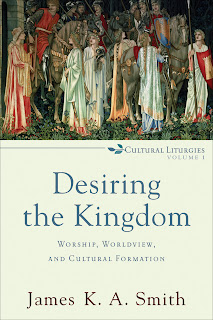
It is my passion for theological intentionality about worship that generated my book Desiring the Kingdom: Worship, Worldview, and Cultural Formation. It's not fair to ask those who read a blog post to read an entire book, but I would invite those who both agreed and those who disagreed with my "Open Letter" to consider Desiring the Kingdom as a fuller articulation of the theology of worship behind my criticisms.

Many of the negative reactions to my missive stem from a fundamentally different understanding of what worship is. That means we are working from fundamentally different starting points. So when someone thinks that I "misunderstand" what's happening in worship, actually I just disagree with the assumptions behind such worship.

I think this is why some have missed two crucial points in my "Open Letter"--points that were admittedly touched on just briefly. Let me reiterate them here:

1. Worship is not only expressive, it is also formative. It is not only how we express our devotion to God, it is also how the Spirit shapes and forms us to bear God's image to the world. This is why the form of worship needs to be intentional: worship isn't just something that we do; it does something to us. And this is why worship in a congregational setting is a communal practice of a congregation by which the Spirit grabs hold of us. How we worship shapes us, and how we worship collectively is an important way of learning to be the body of Christ. (For a helpful account of how our congregational practice of singing embodies the oneness of the body of Christ, see Steve Guthrie's marvelous chapter, "The Wisdom of Song.")

2. Because worship is formative, and not merely expressive, that means other cultural practices actually function as "competing" liturgies, rivals to Christian worship. In Desiring the Kingdom, I analyze examples of such "secular liturgies," including the mall, the stadium, and the university. The point is that such loaded cultural practices are actually shaping our loves and desires by the very form of the practice, not merely by the "content" they offer. If we aren't aware of this, we can unwittingly adopt what seem to be "neutral" or benign practices without recognizing that they are liturgies that come loaded with a rival vision of "the good life." If we adopt such practices uncritically, it won't matter what "content" we convey by them, the practices themselves are ordered to another kingdom. And insofar as we are immersed in them, we are unwittingly mis-shaped by the practices.

Again, there's much more to be said about this, and a blog isn't the venue. I do invite those who have been prompted to think about these matters to consider Desiring the Kingdom as a way to continue the conversation.

Wednesday, February 22, 2012

We're All Atheists Now


This TED talk encapsulates the core thesis of Alain de Botton's new book, Religion for Atheists: A Non-believer's Guide to the Uses of Religion. Anyone who has read Desiring the Kingdom will note obvious overlapping concerns and sensibilities. And while much more deserves to be said (I'll do so in a forthcoming review of the book), here's a question that I think we need to ask ourselves:

Botton is trying to convince atheists and secularists that "religion" has something to teach them. So at the heart of his argument is actually a critique of those versions of atheism/secularism that are dominated by a rationalist anthropology (with a particular focus on the weakness of rationalist models of education). That was Atheism 1.0. As a corrective, he upholds "religion" as a way of life that honors embodiment, recognizes the importance of habituation, appeals to the imagination, etc. If atheism/secularism would adopt these features of religious wisdom and practice, the result would be Atheism 2.0.

But here's the thing: I think many of us located in North American evangelicalism will find that the flattened, stunted "rationalism" of Atheism 1.0 is exactly how we "do" religion. In other words, many of the things that Botton extols about religion are absent from "our" rendition of religion. We might have something to learn from Atheism 2.0.

Monday, February 20, 2012

An Open Letter to Praise Bands

Dear Praise Band,

I so appreciate your willingness and desire to offer up your gifts to God in worship. I appreciate your devotion and celebrate your faithfulness--schlepping to church early, Sunday after Sunday, making time for practice mid-week, learning and writing new songs, and so much more. Like those skilled artists and artisans that God used to create the tabernacle (Exodus 36), you are willing to put your artistic gifts in service to the Triune God.

So please receive this little missive in the spirit it is meant: as an encouragement to reflect on the practice of "leading worship." It seems to me that you are often simply co-opted into a practice without being encouraged to reflect on its rationale, its "reason why." In other words, it seems to me that you are often recruited to "lead worship" without much opportunity to pause and reflect on the nature of "worship" and what it would mean to "lead."

In particular, my concern is that we, the church, have unwittingly encouraged you to simply import musical practices into Christian worship that--while they might be appropriate elsewhere--are detrimental to congregational worship. More pointedly, using language I first employed in Desiring the Kingdom, I sometimes worry that we've unwittingly encouraged you to import certain forms of performance that are, in effect, "secular liturgies" and not just neutral "methods." Without us realizing it, the dominant practices of performance train us to relate to music (and musicians) in a certain way: as something for our pleasure, as entertainment, as a largely passive experience. The function and goal of music in these "secular liturgies" is quite different from the function and goal of music in Christian worship.

So let me offer just a few brief axioms with the hope of encouraging new reflection on the practice of "leading worship":

1. If we, the congregation, can't hear ourselves, it's not worship. Christian worship is not a concert. In a concert (a particular "form of performance"), we often expect to be overwhelmed by sound, particularly in certain styles of music. In a concert, we come to expect that weird sort of sensory deprivation that happens from sensory overload, when the pounding of the bass on our chest and the wash of music over the crowd leaves us with the rush of a certain aural vertigo. And there's nothing wrong with concerts! It's just that Christian worship is not a concert. Christian worship is a collective, communal, congregational practice--and the gathered sound and harmony of a congregation singing as one is integral to the practice of worship. It is a way of "performing" the reality that, in Christ, we are one body. But that requires that we actually be able to hear ourselves, and hear our sisters and brothers singing alongside us. When the amped sound of the praise band overwhelms congregational voices, we can't hear ourselves sing--so we lose that communal aspect of the congregation and are encouraged to effectively become "private," passive worshipers.

2. If we, the congregation, can't sing along, it's not worship. In other forms of musical performance, musicians and bands will want to improvise and "be creative," offering new renditions and exhibiting their virtuosity with all sorts of different trills and pauses and improvisations on the received tune. Again, that can be a delightful aspect of a concert, but in Christian worship it just means that we, the congregation, can't sing along. And so your virtuosity gives rise to our passivity; your creativity simply encourages our silence. And while you may be worshiping with your creativity, the same creativity actually shuts down congregational song.

3. If you, the praise band, are the center of attention, it's not worship. I know it's generally not your fault that we've put you at the front of the church. And I know you want to model worship for us to imitate. But because we've encouraged you to basically import forms of performance from the concert venue into the sanctuary, we might not realize that we've also unwittingly encouraged a sense that you are the center of attention. And when your performance becomes a display of your virtuosity--even with the best of intentions--it's difficult to counter the temptation to make the praise band the focus of our attention. When the praise band goes into long riffs that you might intend as "offerings to God," we the congregation become utterly passive, and because we've adopted habits of relating to music from the Grammys and the concert venue, we unwittingly make you the center of attention. I wonder if there might be some intentional reflection on placement (to the side? leading from behind?) and performance that might help us counter these habits we bring with us to worship.

Please consider these points carefully and recognize what I am not saying. This isn't just some plea for "traditional" worship and a critique of "contemporary" worship. Don't mistake this as a defense of pipe organs and a critique of guitars and drums (or banjos and mandolins). My concern isn't with style, but with form: What are we trying to do when we "lead worship?" If we are intentional about worship as a communal, congregational practice that brings us into a dialogical encounter with the living God--that worship is not merely expressive but also formative--then we can do that with cellos or steel guitars, pipe organs or African drums.

Much, much more could be said. But let me stop here, and please receive this as the encouragement it's meant to be. I would love to see you continue to offer your artistic gifts in worship to the Triune God who is teaching us a new song.

Most sincerely,
Jamie

Update: See the new "Postscript" to this open letter.

Monday, February 13, 2012

C'est fini

Well, I just dropped this off at the offices of Baker Publishing Group: the manuscript for the sequel to Desiring the Kingdom. My working title (we'll see if it survives) is Imagining the Kingdom: How Worship Works.

Now I'm coming up for air. The past two months have been a blur. Deanna has passed along index cards to help me remember the kids' names! There's nothing heroic or virtuous in what I've just done. Indeed, it's like we've lived with a mistress in the house for two months. I'll be using the advance for marital counseling! (Not really--which is in itself a testimony of what an incredibly gracious woman Deanna is.)

From the daily log I kept in my notebook, I see that I created the manuscript file on December 12--the proverbial "blank page" beginning. I ended that day with 829 words. When I finished the book, on February 12, it was just a hair over 95,000. Binge writing at its best/worst. Again, this is not something I recommend.

Now I need to gain some distance from the manuscript for a month or two so that, at the galleys stage, I can come back with a sufficiently critical eye to slash and burn. Right now, while I'm glad to get this off my desk, I have a deep sense of how much the book needs to ferment and mature.

Over the next couple of months I'll sketch some of the core themes and layout the final Table of Contents. Right now it includes a chapter on Merleau-Ponty and another on Bourdieu, trying to marshal their theoretical work as part of a conceptual toolbox to help us think about liturgical formation. They are then enlisted in the second part of the book where I argue for the centrality of the imagination--and hence the aesthetic--in the dynamics of liturgical formation. So while it develops and expands the argument of Desiring the Kingdom, I also hope it finds a new audience amongst those engaged with the arts.

The book is slated to appear in November.

But for now, I'm just glad to bid the manuscript a fond Adieu!

Thursday, February 09, 2012

New College Lectures 2012: JKAS in Australia

I'm honored to announce that I'll be delivering the 2012 New College Lectures at the University of New South Wales in Sydney this coming May. The gracious invitation to give the lectures immediately brought to mind Stanley Hauerwas' powerful little book, After Christendom, as I remembered that it had begun its life as the New College Lectures in 1990. Other previous lecturers have included John Polkinghorne, Elaine Storkey, Oliver O'Donovan, Trevor Hart, Jeremy Begbie, and many others. I'm grateful to be able to contribute to this tradition. And as a Canadian, I'm looking forward to seeing another corner of the Commonwealth.

The theme of my lectures will be Imagining the Kingdom: On Christian Action an will include a one-day conference on Anglican education, picking up and extending themes developed in Desiring the Kingdom. Lectures will be May 23 and 24 with the conference on May 26.

Visit the CASE blog to learn more.

Monday, February 06, 2012

A Discovery: Wilco on Austin City Limits

Late last Saturday night, holed up in a hotel room in Knoxville, working on the final edits for my new book (Imagining the Kingdom: How Worship Works), providence dealt me a little grace: Wilco was playing on PBS' "Austin City Limits."

While Wilco is a huge part of my music library, I've never seen them in concert. So this little glimpse was a revelation for me. Seeing them perform enabled me to appreciate their sound in a whole new way. It's like they're still very much a "live" band that just happens to record their music. Because once you see some of their more atmospheric "noise" (as my wife not-so-affectionately describes it) actually produced by living musicians on real instruments in the synergy of a band, all of a sudden everything makes sense as it never could without that performative context. I feel like I finally "get" Wilco in ways I've never known before.

And then at the end is a marvelous little interview with Tweedy about the creative process that resonated with exactly what I was working on for Imagining the Kingdom--about the intertwinement of artistic creation, aesthetic appreciation, and our preconscious being-in-the-world. Cool stuff.

Watch Wilco on PBS. See more from Austin City Limits.

"Love me, I'm a liberal"

On the lighter side, in lieu of my blog silence: Jonathan Lofft, one of the students I met last summer at Trinity, pointed me to this fun little ditty from Phil Ochs. It's the sort of thing that will make both George-Grantish-curmudgeons and sophomore revolutionaries chortle, but neither will be quite sure whether Ochs is singing for them.


Wednesday, February 01, 2012

Mitt Romney's "Faith in America" Revisited

In light of Romney's decisive win in the Florida primary, over at The Twelve blog I've revisited and recontextualized a post from the last Republican nomination contest. Read more there.