Jeff Sharlet’s most recent essay in Harper’s focuses on yet another front in the Religious Right’s strategy for the culture wars (in addition to the courts, the marriage altar, and science classrooms): U.S. history. At stake here is just how we narrate the story of the American experiment. The Right clearly sees the power of story, and Jon Meacham’s protests in American Gospel to the contrary, they remain committed to a story of biblical proportions—a tale of exiles and promised lands, exoduses and deliverance, cities on hills and New Jerusalems. I’m grateful for another one of Jeffrey Sharlet’s entertaining dispatches from the exotic world of Protestant fundamentalism, giving us a glimpse into the curricula of Christian madrasas located in homes throughout the nation.
I do have some minor reservations about Sharlet’s account—in particular, his suggestion that the Dutch theologian and statesman Abraham Kuyper is something of a progenitor of R.J. Rushdoony’s “dominionist” theocratic project. This is mistaken and over-reaching on at least two counts:
First, while Kuyper did articulate a critique of the sacred/secular distinction, particularly as inherited from the Enlightenment, as well as the liberal notion of “neutrality” in a supposedly secular public square, his critique did not entail any pretension to theocracy. This is because of a central theme in his thought: the notion of “sphere sovereignty” which carefully and rigorously distinguished between the proper realms of authority for the state, the church, commerce, and other spheres. One might suggest this is a kind of Dutch rendition of the “wall of separation.”
Second, we can look at Kuyper’s own practice. As prime minister of the Netherlands, Kuyper’s vision translated into a robust pluralism that has never really been entertained in the United States, not even by the left (taken as they are with the benighted notion of a “neutral” public discourse).
But this is perhaps a bit of a marginal skirmish. More importantly, Sharlet’s piece pushed me to a musical meditation: for the past week I’ve been ruminating on Buddy Miller’s rendition of Bob Dylan’s “With God on our Side,” on Miller’s Universal United House of Prayer album. (You can listen to Miller’s version here.) Tracking the rhetoric of divine sanction of American conflicts—from Puritan violence against Native Americans up to the nuclear age—Dylan interrogates just the claim made by the Religious Right’s version of history: the persistent refrain of “God on our side.” Stand-alone lyrics don’t do justice to the mournful lament, but the song opens:
Oh the history books tell it
They tell it so well
The cavalries charged
The Indians fell
The cavalries charged
The Indians died
Oh the country was young
With God on its side.
The refrain continues through the Revolution, Spanish-American war, up through 20th-century conflicts. But just when this starts to sound like an anthem for manifest destiny, the lyrics take a turn, and conclude thus:
In a many dark hour
I've been thinkin' about this
That Jesus Christ
Was betrayed by a kiss
But I can't think for you
You'll have to decide
Whether Judas Iscariot
Had God on his side.
So now as I'm leavin'
I'm weary as Hell
The confusion I'm feelin'
Ain't no tongue can tell
The words fill my head
And fall to the floor
If God's on our side
He'll stop the next war.
I think the song should be required listening in 7th grade history classes across the country (one could hope it might be listened to by some home schoolers, too!). Dylan’s and Miller’s is a very different story about God’s role in U.S. history—one with a prophetic heritage.

Friday, January 26, 2007
Friday, January 12, 2007
Where's Hitchens on Carter?
Christopher Hitchens has, notoriously, come to a kind of tepid "defense" of the work of David Irving, who is in turn notoriously charged as a Holocaust denier, or at least revisionist. (See "The Strange Case of David Irving," in Hitchens, Love, Poverty, and War.) Hitchens' willingness to even have his name appear in a sentence containing Irving's stems, I think, from Hitch's long-standing advocacy for the Palestinians and thus his willingness to thus toy with something very few American intellectuals will touch: a critique of Israel.
So I find myself waiting for Hitchens to say something about "the Carter affair"--the controversy generated by Carter's new book, Palestine: Peace Not Apartheid. (The NY Times reports today on a number of advisors to the Carter Center resigning over the book.) Granted, Carter is not one of Hitchens' favorites, but neither is he any kind of admirer of Irving. I think Hitchens owes us an intervention on the issues here.
So I find myself waiting for Hitchens to say something about "the Carter affair"--the controversy generated by Carter's new book, Palestine: Peace Not Apartheid. (The NY Times reports today on a number of advisors to the Carter Center resigning over the book.) Granted, Carter is not one of Hitchens' favorites, but neither is he any kind of admirer of Irving. I think Hitchens owes us an intervention on the issues here.

Thursday, January 11, 2007
Carbon Credits: Cheap Grace?
The Martin Marty Center's Sightings post for today is a brilliant piece by Elizabeth Musselman on carbon offsets as the new "indulgences"--a mode of cheap grace that assuages guilt without requiring any change of lifestyle (sort of like the Bush plan to find new drugs for the American addiction to oil, rather than curtail the addiction). The piece is not yet archived on the website, so I'll paste it here:
Carbon Offsets: The New Indulgence? -- Elizabeth Musselman
"Feeling guilty about all those greenhouse gases you generate?" Morning Edition host John Ydstie asked listeners of Martin Kaste's recent National Public Radio story on the thriving carbon offset businesses in the United States. "There may be a way to get out of that eco-guilt, if you're willing to pay." Here's how it works: With the computational help of a website sponsored by the nonprofit organization The Climate Trust, American energy consumers can now compute exactly how much carbon dioxide we emit into the atmosphere every year and then invest proportionally into a company that provides programs to reduce carbon emissions elsewhere in the world. The calculating mechanism enables the energy consumer to donate just enough money to help the company offset the exact amount of pollution generated by that consumer's lifestyle -- no more, no less. Thus, we can continue to drive our SUVs and turn up the heat in the winter without guilt, because by engaging in this financial transaction that Kaste calls "atmospheric penance" we can be reckoned as "carbon neutral."
Guardian commentator George Monbiot compares carbon offset programs to sales of indulgences in medieval Europe. Citing the worst abuses of indulgences (such as the sale of pardons for incest and murder), Monbiot identifies three problems with carbon offset programs. They encourage people to continue to emit carbons now in exchange for the possibility of reduced carbon emissions in the future (and any scientist will admit that an ounce of carbon saved next year isn't as ecologically valuable as an ounce of carbon saved today). Further, they eliminate the sense of guilt that might drive energy consumers toward earth-saving lifestyle and policy changes. Finally, they are simply too little too late. "You can now buy complacency, political apathy, and self-satisfaction. But you cannot buy the survival of the planet." Is Monbiot a modern-day Martin Luther figure, heroically railing against the sale of false ecological salvation to save us from the eschatological terror of environmental collapse? Or should we all purchase carbon offsets after reading this article? Perhaps the answer to both questions is "yes."
Monbiot's easy identification of carbon offsets with indulgences is too simple. As Luther pointed out, indulgences targeted the poor, often keeping salvation-hungry peasants from feeding their families (see the 46th of Luther's 95 Theses). Today, those who feel the most immediate effects of our environmental crisis are the poorest citizens of the world. So in our case, the poor are better off if we do everything we can to slow the impending environmental doom -- which includes financially supporting carbon offset programs. And remember Luther's claim (see thesis 82) that if the Pope really had the power to spring souls from purgatory he should automatically save everyone rather than only those who pay? Similarly, if our financial contributions can really reduce global climate change, shouldn't we automatically contribute everything we can, regardless of how much CO2 we personally emit? But it would still not be enough. Carbon offsets alone won't save our earth from burning any more than indulgences could have saved souls from burning. It is clear that Luther and Monbiot agree on one thing: The reality of sin (read: greed and complacency) makes any simple human effort toward salvation (read: environmental restoration) a mere drop in the bucket. It would take ten billion dollars a year to return the United States to its 1990 levels of greenhouse gas emissions. Even if that could be accomplished, we would still need to change radically the way we live and consume in order to prevent the disaster that many scientists say is now inevitable. Should we donate money to help fund the capture of methane gases on Mexican pig farms and the creation of windmills in India? Yes. Should we stop driving so much? Yes. Should we buy locally? Yes. Should we lobby for policy changes? Yes. The list goes on and on.
In the interest of full disclosure, I should admit that it was near the end of a 2,000-mile solo driving trip that I first heard the NPR story about carbon offsets. Feeling guilty, this theologian and future pastor drove the rest of the way home, donated money to a company that reduces carbon emissions, took the train to school the next day instead of driving -- and then promptly returned to her normal lifestyle. Apparently, it will take more than a temporary feeling of eco-guilt to change my driving habits. And it will take more than carbon offsets for us to save ourselves from the sins of complacency and consumerism that threaten the future of our planet.
References:
Martin Kaste's National Public Radio story "'Carbon Offset' Business Takes Root" (November 28, 2006) can be listened to online at:http://www.npr.org/templates/story/story.php?storyId=6548098&sc=emaf.
The Climate Trust's carbon offset website can be found at http://www.carboncounter.org.
George Monbiot's Guardian article "Selling Indulgences" (October 18, 2006 ) can be accessed at:http://www.monbiot.com/archives/2006/10/19/selling-indulgences/.
Luther's "95 Theses" can be found in Luther's Works: American Edition, vol. 31, ed. Harold Grimm.
Elizabeth Musselman is a Ph.D. candidate in Theology at the University of Chicago Divinity School and a candidate for ordained ministry in the Evangelical Lutheran Church in America.
"No Iraqi Left Behind?"
It seems to me that the President's woefully inadequate proposal for "winning" in Iraq is like a band-aid on a severed jugular. And the logic of the "benchmarks" for Iraqis sounds remarkably similar to the vaunted moralisms of the "No Child Left Behind" Act translated into a foreign policy.
The Council on Foreign Relations provides a helpful panel reaction to last night's speech (though Michael Gerson's contribution is almost laughable in its deference to the administration). Other contributions, however, are insightful yet balanced. To pick just one snippet, Max Boot notes the following:
Gerson, on the other hand, praises a "realistic plan," and lauds the President for being "unimpressed by the conventional foreign policy wisdom" (!). In this way Gerson extends the fundamental anti-intellectualism of this President, who glories in rejecting the "conventional wisdom" of science as well.
The Council on Foreign Relations provides a helpful panel reaction to last night's speech (though Michael Gerson's contribution is almost laughable in its deference to the administration). Other contributions, however, are insightful yet balanced. To pick just one snippet, Max Boot notes the following:
Based on classic counterinsurgency calculations (1 soldier or policeman per 40 or 50 civilians), pacifying Baghdad, a city of 6 million people, requires a force of some 150,000. The beefed-up U.S. force in Baghdad still will be less than 40,000 strong.
Gerson, on the other hand, praises a "realistic plan," and lauds the President for being "unimpressed by the conventional foreign policy wisdom" (!). In this way Gerson extends the fundamental anti-intellectualism of this President, who glories in rejecting the "conventional wisdom" of science as well.
Sunday, December 24, 2006
Pray for the Peace of Bethlehem
Two pieces for reflection: (1) the Archbishop of Canterbury's recent op-ed for The Times on the repercussions of American foreign policy for Christians in the middle east; and (2) Pope Benedict's Christmas message.
Come quickly, Prince of Peace.
Come quickly, Prince of Peace.
Thursday, December 21, 2006
Auden: A "Boxing Day" Selection
On the last day of term I read this selection from W.H. Auden to my class. It is more properly what in Canada (or the UK) we would call a "Boxing Day" poem--an apres-Christmas reflection. But I'll be away from my computer on Boxing Day, so thought I'd share it now:
Well, so that is that. Now we must dismantle the tree,-W.H. Auden (from For the Time Being)
Putting the decorations back into their cardboard boxes --
Some have got broken -- and carrying them up to the attic.
The holly and the mistletoe must be taken down and burnt,
And the children got ready for school. There are enough
Left-overs to do, warmed-up, for the rest of the week --
Not that we have much appetite, having drunk such a lot,
Stayed up so late, attempted -- quite unsuccessfully --
To love all of our relatives, and in general
Grossly overestimated our powers. Once again
As in previous years we have seen the actual Vision and failed
To do more than entertain it as an agreeable
Possibility, once again we have sent Him away,
Begging though to remain His disobedient servant,
The promising child who cannot keep His word for long.
The Christmas Feast is already a fading memory,
And already the mind begins to be vaguely aware
Of an unpleasant whiff of apprehension at the thought
Of Lent and Good Friday which cannot, after all, now
Be very far off. But, for the time being, here we all are,
Back in the moderate Aristotelian city
Of darning and the Eight-Fifteen, where Euclid's geometry
And Newton's mechanics would account for our experience,
And the kitchen table exists because I scrub it.
It seems to have shrunk during the holidays. The streets
Are much narrower than we remembered; we had forgotten
The office was as depressing as this. To those who have seen
The Child, however dimly, however incredulously,
The Time Being is, in a sense, the most trying time of all.
For the innocent children who whispered so excitedly
Outside the locked door where they knew the presents to be
Grew up when it opened. Now, recollecting that moment
We can repress the joy, but the guilt remains conscious;
Remembering the stable where for once in our lives
Everything became a You and nothing was an It.
And craving the sensation but ignoring the cause,
We look round for something, no matter what, to inhibit
Our self-reflection, and the obvious thing for that purpose
Would be some great suffering. So, once we have met the Son,
We are tempted ever after to pray to the Father;
"Lead us into temptation and evil for our sake."
They will come, all right, don't worry; probably in a form
That we do not expect, and certainly with a force
More dreadful than we can imagine. In the meantime
There are bills to be paid, machines to keep in repair,
Irregular verbs to learn, the Time Being to redeem
From insignificance. The happy morning is over,
The night of agony still to come; the time is noon:
When the Spirit must practice his scales of rejoicing
Without even a hostile audience, and the Soul endure
A silence that is neither for nor against her faith
That God's Will will be done, That, in spite of her prayers,
God will cheat no one, not even the world of its triumph.
Thursday, December 14, 2006
Where's the World's Wealth?
The World Institute for Development Economics Research has just released a new study on "The World Distribution of Household Wealth." Unlike the measure of "income," the measure of "wealth" considers household assets and resources. According to the findings of the study, "the richest 1% of adults alone owned 40% of global assets in the year 2000, and that the richest 10% of adults accounted for 85% of the world total. In contrast, the bottom half of the world adult population owned barely 1% of global wealth." (The .pdf version of the report is a rich resource.) Consider the following graphical depictions of just a couple elements:

Thursday, December 07, 2006
Who "Supports Our Troops?"
My oldest son and I listened with rapt attention to a recent NPR report on the persecution of soldiers returning from Iraq with Post-Traumatic Stree Disorder (PTSD). Definitely worth a listen (or a read: the transcripts are online--but I would recommend listening). The report is riveting, heart-breaking and angering all at the same time. The human cost of this war is staggering, and it is remarkable how the administration and the military itself is failing to support our troops.
Wednesday, November 29, 2006
The Pope in Turkey
Since arriving in Turkey, the Pope has described Islam as a "religion of peace" and stated that Turkey should be admitted into the European union? I can't way to see what Fr. Neuhaus, George Weigel and the National Review are going to do with those claims.
Friday, November 24, 2006
Scientism Evangelistic Rally
A recent article in the New York Times provides a fascinating peek inside what could only be described as an evangelistic planning rally for scientism--the religion of Richard Dawkins, Sam Harris, and their ilk. Very entertaining reading, especially for anyone who has ever attended an evangelistic crusade (that is, about 1.2% of NYT readers!).
But the article is also disheartening: is there any hope of people actually talking to one another in our polarized culture? Or are we doomed to live in tribalistic quadrants carved up by the polemic of talk radio, cynically preaching to our respective choirs?
But the article is also disheartening: is there any hope of people actually talking to one another in our polarized culture? Or are we doomed to live in tribalistic quadrants carved up by the polemic of talk radio, cynically preaching to our respective choirs?
Monday, November 13, 2006
Postcard from Belgium
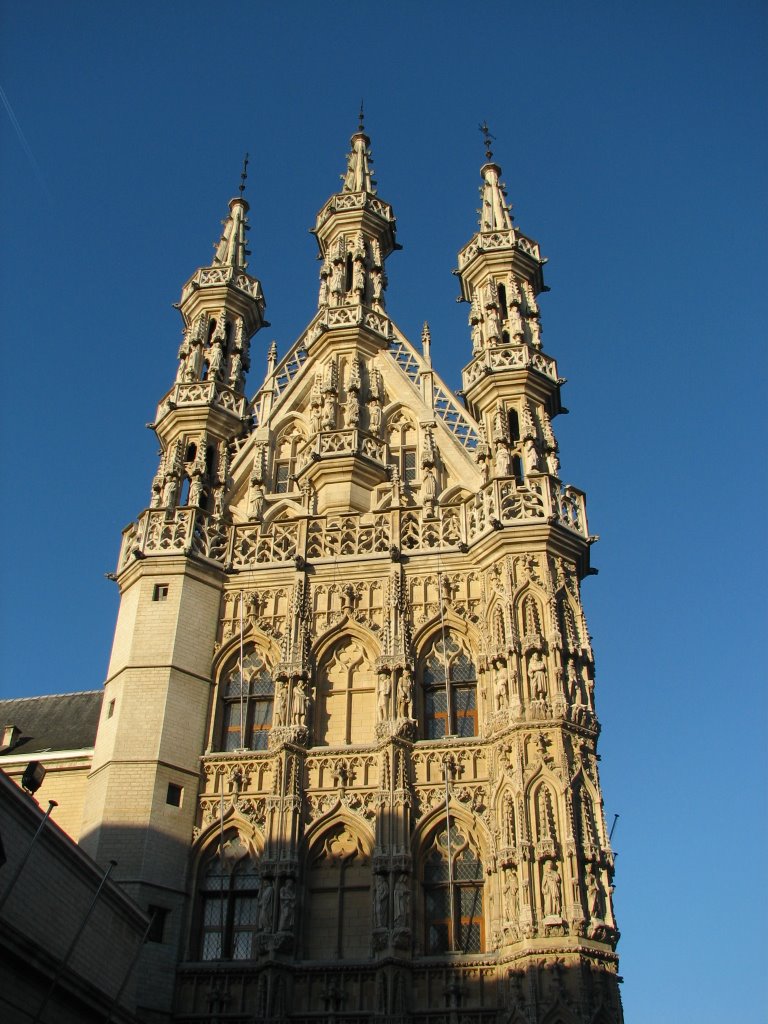
I just returned from a fabulous conference at the Katholieke Universiteit in Leuven, Belgium on "Augustine and Postmodernism: A New Alliance Against Modernity?" (9-11 November), hosted by Lieven Boeve and Tom Jacobs--who did a wonderful job both pulling together a stimulating team of scholars for this colloquium, and then providing unparalleled hospitality that nourished our conversations. Here are just a few pictures and reflections.
Leuven, a late medieval city in the Flemish part of Belgium, is a very short train ride from Brussels. The Katholieke Universiteit (Catholic University)--is a core feature of the town and students are everywhere. It is very much a "university city" and given its size and history, it reminded me of Cambridge in many ways. Pictured here is the famous Town Hall of Leuven, a quintessentially Gothic structure completed in 1468.
Leuven's Faculties of Theology and Philosophy are internationally esteemed. The theology
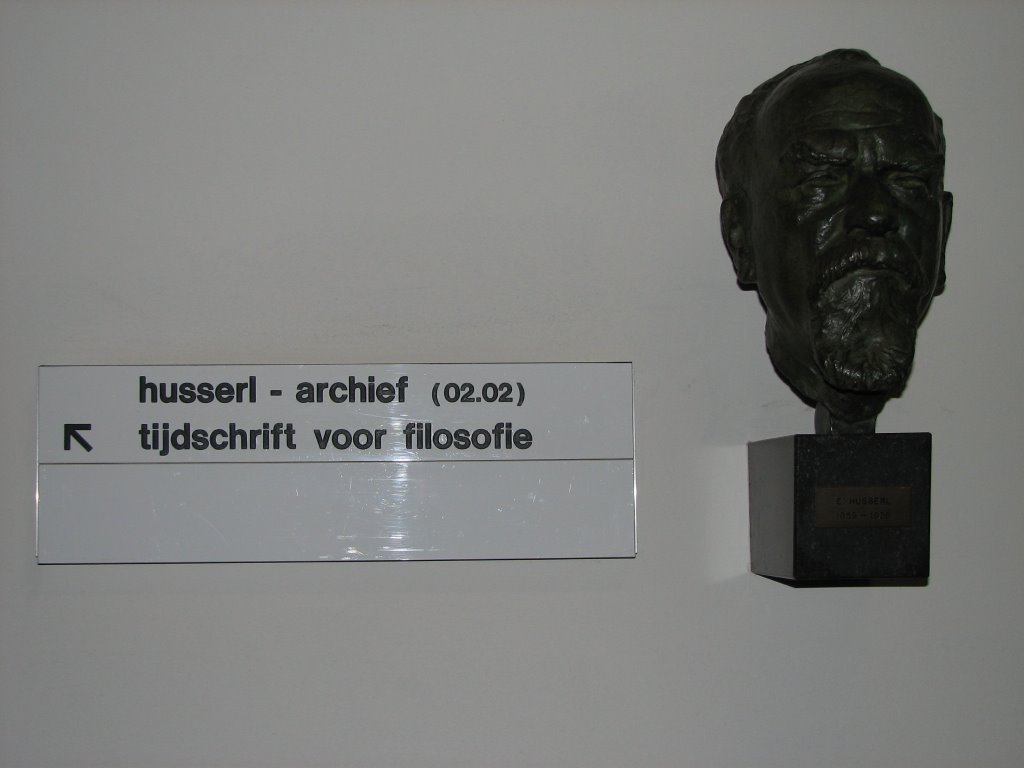 faculty made a mark on Vatican II (indeed, some of the conversations at our conference circled back to consider just what was at stake at the council and what it would mean to continue--or contest--that legacy) and has continued to generate important work, including recent engagements with postmodernity. The Institute of Philosophy is home to the Husserl Archives and has for decades been one of the premier influences on contemporary phenomenology. So it was a treat for me to make a bit of a 'pilgrimmage' to the Husserl Archives while I was there.
An unanticipated treat was Belgian cuisine. Our hosts showed us a wonderful time in local establishments. While I came with high expectations for Belgian beer (I learned that Stella Artois constitutes the dregs of Belgian beer that they send to us in the America, saving the best stuff for themselves!), I enjoyed several excellent dining experiences. These included a tantalizing pork dish (covered with Danish blue cheese) on Friday night, followed with a Saturday lunch of steak, peppercorn cream sauce, frites (which the Belgians, not the French, invented!), and a glass of Duvel. This was topped off when I visited some new friends, the Micheners, on Saturday in the Wallonie (French-speaking) region of Belgium (just south of Leuven). There I enjoyed "raclette," which is both a kind of cheese and a mode of preparation: cheeses, meats, and vegetables prepared in a central table-top grill, then poured over Belgian potatoes and complemented by French wine. Yeah, the airline food the next day was, er, a bit of a step down from all that!
The conference conversation--focused on the role that Augustine plays (should play, could play) in contemporary theology and, in particular, theological accounts of cultural engagement--was top-notch and stimulating. The conference was organized as what they described as an "expert colloquium"--a sort of closed-door roundtable discussion with a few folks listening in. Some of the other speakers including two of my former teachers (Robert Dodaro from the Augustinianum in Rome and Anthony Godzieba from Villanova) as well as folks like Fergus Kerr and Emmanuel Falque (from the Institut Catholique in Paris), and several very sharp younger scholars (including Holger Zaborowski). The proceedings of the conference will be published next year. But most importantly, the conversation--at times animated--really helped me to crystallize some of the key issues I need to think about as I'm trying to develop an Augustinian political phenomenology.
One of the other delights of being in Belgium was getting to know the good folks at the Evangelical Theological Faculty on the south side of Leuven. Having briefly met Ron Michener once before, I enjoyed a morning of conversation with Ron, Patrick Nullens, Filip Cavel, and a couple of other doctoral students about the challenges and opportunities for evangelical theology in Europe.
Thursday, November 09, 2006
God's Politics?
I don't mean to keep flogging the same horse, but man I find Jim Wallis frustrating! A couple of recent occasions for new ire:
1. On the flight over to Belgium, I caught up listening to some of Krista Tippett's Speaking of Faith podcasts, including a conversation with former Republican Senator and Episcopal priest, John Danforth on "Conservative Politics and Moderate Religion" (I think I would prefer moderate politics and conservative religion, but don't hold me to that). Danforth has been shilling his new book Faith and Politics in which he seems to conclude that if someone takes a "position" on something, and claims that it is God's position on something, then one is being "divisive"--and being divisive seems to be the cardinal sin for Danforth. If one quips that Jesus was pretty decisive, I'm guessing that Danforth would say 'that's different' because Jesus was God (though he's an Episcopalian priest, so I can't say for sure). In any case, while I'm all for humility (and goodness knows we need more of it in public discourse [and I am the chief of sinners]), such castigations of "divisiveness" strike me as, in fact, false humility--which doesn't help anyone. Danforth is just a popularized version of John Rawls. (While I'm a bit hesitant to make the link, because of guilt by association, intellectual honesty compels me to note that Ramesh Ponnuru's review of Danforth's book in the National Review gets this point right.)
But Danforth's wishy-washy-ness helped to highlight (again) how much Jim Wallis is playing the same game as the Religious Right--they just disagree about specifics. While Wallis is as critical of the Religious Right as anyone--and the Right is clearly the target of Danforth's book--anyone who writes a book entitled God's Politics is working with the same tools. Wallis' constantianism of the left is (or should be) just as much a target of Danforth's critique as Dobson and Falwell.
2. And now, after the Democrat's (seeming) sweep of the mid-term elections, Jim Wallis is claiming that it was the Christian left who were the deciding factor in giving the Dems victory (see also Christianity Today's nice online piece, "Declaring Victory"). Wallis is still jealous, I guess, about all the press's causal claims about the role of the Religious Right in '04. But this evokes a couples responses.
First: Really? But is there any data to support this claim? Exit poll questions were asking this? Methinks there's some serious over-estimation going on here, tied to a certain over-estimation of Wallis' own importance.
Second, there is a remarkable irony about Wallis' posturing. At one point Wallis says this: "When Democrats can run authentically as persons of faith, they can beat back the idolatrous claims of the Religious Right that God is only on their side." This from a guy who has the audacity to write a book called God's Politics. I think the "only" in this quote is superfluous, and masks the fact that Wallis thinks that God is on his side.
1. On the flight over to Belgium, I caught up listening to some of Krista Tippett's Speaking of Faith podcasts, including a conversation with former Republican Senator and Episcopal priest, John Danforth on "Conservative Politics and Moderate Religion" (I think I would prefer moderate politics and conservative religion, but don't hold me to that). Danforth has been shilling his new book Faith and Politics in which he seems to conclude that if someone takes a "position" on something, and claims that it is God's position on something, then one is being "divisive"--and being divisive seems to be the cardinal sin for Danforth. If one quips that Jesus was pretty decisive, I'm guessing that Danforth would say 'that's different' because Jesus was God (though he's an Episcopalian priest, so I can't say for sure). In any case, while I'm all for humility (and goodness knows we need more of it in public discourse [and I am the chief of sinners]), such castigations of "divisiveness" strike me as, in fact, false humility--which doesn't help anyone. Danforth is just a popularized version of John Rawls. (While I'm a bit hesitant to make the link, because of guilt by association, intellectual honesty compels me to note that Ramesh Ponnuru's review of Danforth's book in the National Review gets this point right.)
But Danforth's wishy-washy-ness helped to highlight (again) how much Jim Wallis is playing the same game as the Religious Right--they just disagree about specifics. While Wallis is as critical of the Religious Right as anyone--and the Right is clearly the target of Danforth's book--anyone who writes a book entitled God's Politics is working with the same tools. Wallis' constantianism of the left is (or should be) just as much a target of Danforth's critique as Dobson and Falwell.
2. And now, after the Democrat's (seeming) sweep of the mid-term elections, Jim Wallis is claiming that it was the Christian left who were the deciding factor in giving the Dems victory (see also Christianity Today's nice online piece, "Declaring Victory"). Wallis is still jealous, I guess, about all the press's causal claims about the role of the Religious Right in '04. But this evokes a couples responses.
First: Really? But is there any data to support this claim? Exit poll questions were asking this? Methinks there's some serious over-estimation going on here, tied to a certain over-estimation of Wallis' own importance.
Second, there is a remarkable irony about Wallis' posturing. At one point Wallis says this: "When Democrats can run authentically as persons of faith, they can beat back the idolatrous claims of the Religious Right that God is only on their side." This from a guy who has the audacity to write a book called God's Politics. I think the "only" in this quote is superfluous, and masks the fact that Wallis thinks that God is on his side.
Saturday, November 04, 2006
Praying for Ted
This morning, while trying to undo autumn's leafy deposits across the backyard, I found myself--much to my surprise--praying for Ted Haggard. To be sure, Haggard represents almost everything I loathe about the Religious Right and the Babylonian captivity of evangelicalism (captured so well in Jeff Sharlet's Harper's piece a while back). And news of these allegations has made leftist bloggers just downright giddy.
But it's curious how this explosion in Haggard's life could be a reminder that, despite our political differences, Ted Haggard is still a brother. (And maybe this is a tiny little confirmation that, despite all my protests to the contrary, I'm still an evangelical.) Recent video of Haggard in his SUV, with his wife in the passenger seat, was one of the most painful snippets I've seen in a while. Forced to revise his story (I think common sense should tell us to expect further revisions), Haggard's tired eyes keep darting to his wife's face as he has to confess to compromises and failures (the camera's gaze is almost merciful in not showing her face).
While sociologists are constantly looking for the defining features of "evangelicals," I wonder if the Haggard case might provide a more visceral criterion: if you see what Haggard and his family are going through, and are moved to consider their pain, and have a haunting but persistent sense that "there, but for the grace of God go I"--then you're an evangelical. Evangelicals in their best moments are painfully aware of the brokenness of our world, and of our very selves--even our redeemed selves. And thus struggle to answer the Spirit's call to "weep with those who weep" (Rom. 12:15).
"Let him who thinks he stands take heed lest he fall" (1 Cor. 10:12).
But it's curious how this explosion in Haggard's life could be a reminder that, despite our political differences, Ted Haggard is still a brother. (And maybe this is a tiny little confirmation that, despite all my protests to the contrary, I'm still an evangelical.) Recent video of Haggard in his SUV, with his wife in the passenger seat, was one of the most painful snippets I've seen in a while. Forced to revise his story (I think common sense should tell us to expect further revisions), Haggard's tired eyes keep darting to his wife's face as he has to confess to compromises and failures (the camera's gaze is almost merciful in not showing her face).
While sociologists are constantly looking for the defining features of "evangelicals," I wonder if the Haggard case might provide a more visceral criterion: if you see what Haggard and his family are going through, and are moved to consider their pain, and have a haunting but persistent sense that "there, but for the grace of God go I"--then you're an evangelical. Evangelicals in their best moments are painfully aware of the brokenness of our world, and of our very selves--even our redeemed selves. And thus struggle to answer the Spirit's call to "weep with those who weep" (Rom. 12:15).
"Let him who thinks he stands take heed lest he fall" (1 Cor. 10:12).
Thursday, November 02, 2006
A Miscellany
Just a few recent pieces of note that others may find of interest:
- A wonderful essay by Alasdair MacIntrye: "The End of Education: The Fragmentation of the American University" over at Commonweal (HT: Jeff Bouman)
- Martin Marty on "theocracy" in Sightings
- Brian Leiter, with whom I'm not often prone to agree, has an interesting post on "Why I am Not a Liberal"
- A downright spooky article about "extreme" evangelist Stephen Baldwin (yes, he's one of those Baldwins)
Monday, October 16, 2006
The Lonely Commute
Last spring I taught a seminar on "Urban Altruism" that explored the material conditions of community--how aspects of urban planning, architecture, and other social arrangements either foster or detract from community-building (friendships, civic concern, neighbor-love, etc.). Two recent reports confirm much of what we discussed in the class:
1. This past summer the American Sociological Review published a landmark study on "Social Isolation in America" (pdf). Over a twenty year period, the study considers the change in the circle of close friends ("confidants") that Americans have. Over the 20-year span these social networks decreased by 1/3. This might be at least partially be explained by a report unveiled this week...
2. The Transportation Research Board released the third edition of its report, Commuting in America. The report indicates that the lonely commute has gotten even lonlier: as more commuting traffics from suburb to suburb (rather than suburb to core city), the number of new solo drivers grew by almost 13 million from 1990 to 2000. The report also indicates that the number of workers with commutes over 60 minutes grew by 50 percent (!), and that more Americans are leaving for work between 5:00-6:30am.
Pretty hard to cultivate significant friendships when we're spending so much time by ourselves in our cars. Instead, we have more and more people listening to the inanity of talk radio in America. Someone needs to do a study that consider the correlation between increased solo commuting, the explosion of talk radio, and the increased polarization of American "civic" discourse.
1. This past summer the American Sociological Review published a landmark study on "Social Isolation in America" (pdf). Over a twenty year period, the study considers the change in the circle of close friends ("confidants") that Americans have. Over the 20-year span these social networks decreased by 1/3. This might be at least partially be explained by a report unveiled this week...
2. The Transportation Research Board released the third edition of its report, Commuting in America. The report indicates that the lonely commute has gotten even lonlier: as more commuting traffics from suburb to suburb (rather than suburb to core city), the number of new solo drivers grew by almost 13 million from 1990 to 2000. The report also indicates that the number of workers with commutes over 60 minutes grew by 50 percent (!), and that more Americans are leaving for work between 5:00-6:30am.
Pretty hard to cultivate significant friendships when we're spending so much time by ourselves in our cars. Instead, we have more and more people listening to the inanity of talk radio in America. Someone needs to do a study that consider the correlation between increased solo commuting, the explosion of talk radio, and the increased polarization of American "civic" discourse.
Saturday, October 14, 2006
Do Tax Breaks "Establish" Religion?
[Breaking blog silence here. General craziness has kept me from spending much time on Fors Clavigera. What blogging time/energy I've had has gone into The Church and Postmodern Culture blog and Generous Orthodoxy Think Tank.]
The New York Times recently published an interesting series of articles on the ways in which religious organizations receive all kinds of benefits and exemptions from various agencies and arms of the federal government: see "In God's Name," Part 1, Part 2, Part 3, Part 4.
Granted, such policies do not seem to violate the "establishment" clause, since the same benefits are extended to all religions. So the government is clearly not in the business of establishing "a" religion. However, the Part 4 article raises a question that has always nagged me: what about non-religious ("secular") organizations and individuals who sacrificially devote themselves to the common good? Should the pastor of the megachurch in a wealthy Chicago suburb get tax-free housing, while the inner-city teacher who devotes her life to serving the disadvantaged does not? While such policies do not establish "a" religion, they do seem to establish "religion" over non-religious commitments to serve the common good. And it doesn't seem to me that a "liberal" or constitutionally "secular" state has the resources to extend such benefits to religious organizations but not non-religious ones.
The New York Times recently published an interesting series of articles on the ways in which religious organizations receive all kinds of benefits and exemptions from various agencies and arms of the federal government: see "In God's Name," Part 1, Part 2, Part 3, Part 4.
Granted, such policies do not seem to violate the "establishment" clause, since the same benefits are extended to all religions. So the government is clearly not in the business of establishing "a" religion. However, the Part 4 article raises a question that has always nagged me: what about non-religious ("secular") organizations and individuals who sacrificially devote themselves to the common good? Should the pastor of the megachurch in a wealthy Chicago suburb get tax-free housing, while the inner-city teacher who devotes her life to serving the disadvantaged does not? While such policies do not establish "a" religion, they do seem to establish "religion" over non-religious commitments to serve the common good. And it doesn't seem to me that a "liberal" or constitutionally "secular" state has the resources to extend such benefits to religious organizations but not non-religious ones.
Saturday, August 05, 2006
Driving Through the Fly-Over States
For the sixth time since 1999, our family is making a cross-country trek to California: 1 minivan, 2 adults, 4 kids, 2200 miles (x2), 3 days, 6 people/hotel room. You do the math.
But there's no better way to see America--indeed, no more "American" way to see America--than to drive it. In particular, I was struck this time how few cultural commentators actually drive through these "fly over" states. We should admit that there's a class element at work here: if you're driving across Nebraska and Wyoming to enjoy time in the Napa Valley, then chances are you can't really afford to be hanging out in the Napa Valley. And so driving across the fly-over states is a bit like riding the city bus: you meet an "interesting" cross-section of people (a massive Harley-Davidson rally in Sturgis, SD filled I-80 with bikes and people of all kinds). But this is just to be reminded that the world is bigger than the comfy, educated confines of the East Coast.
So most of the cultural elites who get to comment on culture spend very little time in these regions of "red" America. Now granted, I can understand why: for instance, in the hotels we stay at (only requirement: free continental breakfast must be included; our family of 6 makes a killing on that :-), even CNN is too liberal, so unlike the airports of the flying class, the lobbies and breakfast nooks of these fly-over hotels blare FOX News at all hours. (I thought I was going to have a coronary when forced into the same room as their coverage of the Israel/Lebanon conflict this morning.) And civil religion is in full swing in these parts, all under the rubric of the "heartland" (why does that call to mind the German Heimat?)--as in the "Heartland Museum of Military Vehicles" in Lexington, NE, or the Wal-mart temples that are found in even the most obscure places out here.
Curious sightings, too: like in central Nebraska, when we whizzed past a huge, hand-painted sign that proclaimed in scrawled letters: "Outlaw Sodomy." Who exactly is the audience for this sign? And what's the impetus? It's not like there's a huge influx of the "creative class" in Gothenberg, NE. A cynical scan of the local demographics had me wondering if maybe this was a sign the local livestock had erected.
But for all that, there's still an inestimable charm about the fly-over states. One finds oneself drawn into long conversations at gas stations and drive-thrus, just because folks are so darn friendly. And for all the critique of the idolatry of "manifest destiny," it was still a bit of a boyhood dream when we visited a Pony Express station in NE, and found in there a gracious, dignified older woman who shared with our kids the story--without too much propaganda--of the shortlived Pony Express.
And, of course, there's the geography: the unbelievable array of colors and curvatures as one moves across the corn states, through the plains, into the desert and up the mountains. And that's just one day! Groves on the edge of tiny lakes in Nebraska seem to be hiding young lovers curled up in the grass or skinny dipping under the trees; at times western Wyoming looks like a lunar landscape, while at other times the Wyoming sky is so vast and sprawling that one thinks it just might be falling.
So I don't consider driving through the fly-over states a drudgery (even if, I confess, I too easily lapse into a kind of East Coast cynicism about middle-American 'culture'--as if somebody from Grand Rapids, MI has any right to be a snob! ;-). Rather, I consider this cross-country ritual both a discipline and a blessing: field research, and an opportunity to be enriched. And I hope this sinks into my kids' blood, so that even if they make it into that "class" which can afford to fly-over this expanse, they'll choose not to--because they'll know what they're missing.
But there's no better way to see America--indeed, no more "American" way to see America--than to drive it. In particular, I was struck this time how few cultural commentators actually drive through these "fly over" states. We should admit that there's a class element at work here: if you're driving across Nebraska and Wyoming to enjoy time in the Napa Valley, then chances are you can't really afford to be hanging out in the Napa Valley. And so driving across the fly-over states is a bit like riding the city bus: you meet an "interesting" cross-section of people (a massive Harley-Davidson rally in Sturgis, SD filled I-80 with bikes and people of all kinds). But this is just to be reminded that the world is bigger than the comfy, educated confines of the East Coast.
So most of the cultural elites who get to comment on culture spend very little time in these regions of "red" America. Now granted, I can understand why: for instance, in the hotels we stay at (only requirement: free continental breakfast must be included; our family of 6 makes a killing on that :-), even CNN is too liberal, so unlike the airports of the flying class, the lobbies and breakfast nooks of these fly-over hotels blare FOX News at all hours. (I thought I was going to have a coronary when forced into the same room as their coverage of the Israel/Lebanon conflict this morning.) And civil religion is in full swing in these parts, all under the rubric of the "heartland" (why does that call to mind the German Heimat?)--as in the "Heartland Museum of Military Vehicles" in Lexington, NE, or the Wal-mart temples that are found in even the most obscure places out here.
Curious sightings, too: like in central Nebraska, when we whizzed past a huge, hand-painted sign that proclaimed in scrawled letters: "Outlaw Sodomy." Who exactly is the audience for this sign? And what's the impetus? It's not like there's a huge influx of the "creative class" in Gothenberg, NE. A cynical scan of the local demographics had me wondering if maybe this was a sign the local livestock had erected.
But for all that, there's still an inestimable charm about the fly-over states. One finds oneself drawn into long conversations at gas stations and drive-thrus, just because folks are so darn friendly. And for all the critique of the idolatry of "manifest destiny," it was still a bit of a boyhood dream when we visited a Pony Express station in NE, and found in there a gracious, dignified older woman who shared with our kids the story--without too much propaganda--of the shortlived Pony Express.
And, of course, there's the geography: the unbelievable array of colors and curvatures as one moves across the corn states, through the plains, into the desert and up the mountains. And that's just one day! Groves on the edge of tiny lakes in Nebraska seem to be hiding young lovers curled up in the grass or skinny dipping under the trees; at times western Wyoming looks like a lunar landscape, while at other times the Wyoming sky is so vast and sprawling that one thinks it just might be falling.
So I don't consider driving through the fly-over states a drudgery (even if, I confess, I too easily lapse into a kind of East Coast cynicism about middle-American 'culture'--as if somebody from Grand Rapids, MI has any right to be a snob! ;-). Rather, I consider this cross-country ritual both a discipline and a blessing: field research, and an opportunity to be enriched. And I hope this sinks into my kids' blood, so that even if they make it into that "class" which can afford to fly-over this expanse, they'll choose not to--because they'll know what they're missing.
Sunday, July 30, 2006
The Sunday Paper in 1984
Fors Clavigera was launched in an Orwellian spirit disappointed, frustrated, and at times frightened by a world too much like that of 1984. While posts along that line have subsided, the external realities have not. Today's local paper carried several articles that confirm the point:
It's precisely things like this that make it not so hard to understand how even some really sharp scholars like David Ray Griffin can be suspicious to the point of arguing for US government involvement in 9/11. See the site of the Muslim-Jewish-Christian Allienace for 9/11 Truth (apparently no savvy web-designers have joined the team), Scholars for 9/11 Truth, and a fairly comprehensive and interesting article from the Chronicle of Higher Education on the phenomenon.
- A New York Times piece noting that the "family values" cynics otherwise known as Republicans in the House passed a bill to raise the minimum wage only because they also tacked on a little proposal to also decrease the estate tax--a change only of interest to the wealthiest echelons of this country. And so these bastards get to say that they voted to raise the minimum wage, all the while knowing the Democrats in the Senate will sink the proposal because of the estate tax addendum. This is shear sophistry, promulgated by Bible-belt conservatives in a move that is so cynical and nihilist that even Nietzsche would blush.
- A nearly week-old AP piece documenting how minimalist Bush protesters--people who simply wore anti-Bush T-shirst to rallies, for instance--were arrested and handcuffed at a number of events, including not just Republican party events, but tax-payer funded public events. (For analysis, rent V for Vendetta, out on DVD on Tuesday.)
- Then in the Opinions section the Grand Rapids Press treated us (as usual) to Michael Ramirez's 7/27/06 cartoon propoganda regarding Israel, while a Reuters headline today document that an Israeli airstrike had killed 60 civilians, including at least 37 children--while the White House gave poor Israel time to work things out (and Beirut promptly let Condi Rice know that she wasn't welcome for tea, sympathy, or a piano concerto).
It's precisely things like this that make it not so hard to understand how even some really sharp scholars like David Ray Griffin can be suspicious to the point of arguing for US government involvement in 9/11. See the site of the Muslim-Jewish-Christian Allienace for 9/11 Truth (apparently no savvy web-designers have joined the team), Scholars for 9/11 Truth, and a fairly comprehensive and interesting article from the Chronicle of Higher Education on the phenomenon.
Monday, July 24, 2006
Conservative Temptations
Frustrations with what passes for the "left" AND "right" in this country have found me re-considering the possibility that I might be a "conservative" (!). Of course this has nothing whatsoever to do with the kabal of free-market revolutionaries who somehow convinced the world that they were conservatives. Rather, I mean a good, old, real conservatism--which flirts with feudalism, aristocracy and English "gentlemen"--not the banalities of the nouveau riche or the oligarchy that passes itself off as democratic.
In this vein, I find myself more and more drawn (not convinced, I'd say, but charitably listening) to someone like Roger Scruton. Thanks to the New Pantagruel for publishing a delightful interview with Scruton, "The Joy of Conservatism."
In this vein, I find myself more and more drawn (not convinced, I'd say, but charitably listening) to someone like Roger Scruton. Thanks to the New Pantagruel for publishing a delightful interview with Scruton, "The Joy of Conservatism."
Subscribe to:
Posts (Atom)