For the sixth time since 1999, our family is making a cross-country trek to California: 1 minivan, 2 adults, 4 kids, 2200 miles (x2), 3 days, 6 people/hotel room. You do the math.
But there's no better way to see America--indeed, no more "American" way to see America--than to drive it. In particular, I was struck this time how few cultural commentators actually drive through these "fly over" states. We should admit that there's a class element at work here: if you're driving across Nebraska and Wyoming to enjoy time in the Napa Valley, then chances are you can't really afford to be hanging out in the Napa Valley. And so driving across the fly-over states is a bit like riding the city bus: you meet an "interesting" cross-section of people (a massive Harley-Davidson rally in Sturgis, SD filled I-80 with bikes and people of all kinds). But this is just to be reminded that the world is bigger than the comfy, educated confines of the East Coast.
So most of the cultural elites who get to comment on culture spend very little time in these regions of "red" America. Now granted, I can understand why: for instance, in the hotels we stay at (only requirement: free continental breakfast must be included; our family of 6 makes a killing on that :-), even CNN is too liberal, so unlike the airports of the flying class, the lobbies and breakfast nooks of these fly-over hotels blare FOX News at all hours. (I thought I was going to have a coronary when forced into the same room as their coverage of the Israel/Lebanon conflict this morning.) And civil religion is in full swing in these parts, all under the rubric of the "heartland" (why does that call to mind the German Heimat?)--as in the "Heartland Museum of Military Vehicles" in Lexington, NE, or the Wal-mart temples that are found in even the most obscure places out here.
Curious sightings, too: like in central Nebraska, when we whizzed past a huge, hand-painted sign that proclaimed in scrawled letters: "Outlaw Sodomy." Who exactly is the audience for this sign? And what's the impetus? It's not like there's a huge influx of the "creative class" in Gothenberg, NE. A cynical scan of the local demographics had me wondering if maybe this was a sign the local livestock had erected.
But for all that, there's still an inestimable charm about the fly-over states. One finds oneself drawn into long conversations at gas stations and drive-thrus, just because folks are so darn friendly. And for all the critique of the idolatry of "manifest destiny," it was still a bit of a boyhood dream when we visited a Pony Express station in NE, and found in there a gracious, dignified older woman who shared with our kids the story--without too much propaganda--of the shortlived Pony Express.
And, of course, there's the geography: the unbelievable array of colors and curvatures as one moves across the corn states, through the plains, into the desert and up the mountains. And that's just one day! Groves on the edge of tiny lakes in Nebraska seem to be hiding young lovers curled up in the grass or skinny dipping under the trees; at times western Wyoming looks like a lunar landscape, while at other times the Wyoming sky is so vast and sprawling that one thinks it just might be falling.
So I don't consider driving through the fly-over states a drudgery (even if, I confess, I too easily lapse into a kind of East Coast cynicism about middle-American 'culture'--as if somebody from Grand Rapids, MI has any right to be a snob! ;-). Rather, I consider this cross-country ritual both a discipline and a blessing: field research, and an opportunity to be enriched. And I hope this sinks into my kids' blood, so that even if they make it into that "class" which can afford to fly-over this expanse, they'll choose not to--because they'll know what they're missing.

Saturday, August 05, 2006
Sunday, July 30, 2006
The Sunday Paper in 1984
Fors Clavigera was launched in an Orwellian spirit disappointed, frustrated, and at times frightened by a world too much like that of 1984. While posts along that line have subsided, the external realities have not. Today's local paper carried several articles that confirm the point:
It's precisely things like this that make it not so hard to understand how even some really sharp scholars like David Ray Griffin can be suspicious to the point of arguing for US government involvement in 9/11. See the site of the Muslim-Jewish-Christian Allienace for 9/11 Truth (apparently no savvy web-designers have joined the team), Scholars for 9/11 Truth, and a fairly comprehensive and interesting article from the Chronicle of Higher Education on the phenomenon.
- A New York Times piece noting that the "family values" cynics otherwise known as Republicans in the House passed a bill to raise the minimum wage only because they also tacked on a little proposal to also decrease the estate tax--a change only of interest to the wealthiest echelons of this country. And so these bastards get to say that they voted to raise the minimum wage, all the while knowing the Democrats in the Senate will sink the proposal because of the estate tax addendum. This is shear sophistry, promulgated by Bible-belt conservatives in a move that is so cynical and nihilist that even Nietzsche would blush.
- A nearly week-old AP piece documenting how minimalist Bush protesters--people who simply wore anti-Bush T-shirst to rallies, for instance--were arrested and handcuffed at a number of events, including not just Republican party events, but tax-payer funded public events. (For analysis, rent V for Vendetta, out on DVD on Tuesday.)
- Then in the Opinions section the Grand Rapids Press treated us (as usual) to Michael Ramirez's 7/27/06 cartoon propoganda regarding Israel, while a Reuters headline today document that an Israeli airstrike had killed 60 civilians, including at least 37 children--while the White House gave poor Israel time to work things out (and Beirut promptly let Condi Rice know that she wasn't welcome for tea, sympathy, or a piano concerto).
It's precisely things like this that make it not so hard to understand how even some really sharp scholars like David Ray Griffin can be suspicious to the point of arguing for US government involvement in 9/11. See the site of the Muslim-Jewish-Christian Allienace for 9/11 Truth (apparently no savvy web-designers have joined the team), Scholars for 9/11 Truth, and a fairly comprehensive and interesting article from the Chronicle of Higher Education on the phenomenon.

Monday, July 24, 2006
Conservative Temptations
Frustrations with what passes for the "left" AND "right" in this country have found me re-considering the possibility that I might be a "conservative" (!). Of course this has nothing whatsoever to do with the kabal of free-market revolutionaries who somehow convinced the world that they were conservatives. Rather, I mean a good, old, real conservatism--which flirts with feudalism, aristocracy and English "gentlemen"--not the banalities of the nouveau riche or the oligarchy that passes itself off as democratic.
In this vein, I find myself more and more drawn (not convinced, I'd say, but charitably listening) to someone like Roger Scruton. Thanks to the New Pantagruel for publishing a delightful interview with Scruton, "The Joy of Conservatism."
In this vein, I find myself more and more drawn (not convinced, I'd say, but charitably listening) to someone like Roger Scruton. Thanks to the New Pantagruel for publishing a delightful interview with Scruton, "The Joy of Conservatism."
Tuesday, July 11, 2006
Barack Obama: Another Reason to Leave the Christian Left
First, given what I'll say in a moment, let me state for the record (again!) that I am no fan, supporter or sympathizer of the Religious Right. To the contrary. But there seems to be no shortage of Christian scholars, pundits, and armchair cultural critics pointing out the inadequacies, inconsistencies, and injustices of the Religious Right. Why repeat it here?
Instead, I tend to be more motivated to point out the deficiencies of what passes for the "Religious Left" in this country. ("Left" is clearly a relative term, since I rarely hear the Christian "left" in this country really challenge the mechanisms of capitalist, market economies. Here a Victorian, Christian socialist like F.D. Maurice makes Jim Wallis sound like a PR rep for Wal-Mart. But I digress...) Unfortunately, however, in the bifurcated world we inhabit, if you're not with us, you're against us. So my critique of the Christian Left is too often immediately mistaken as an indicator that I'm a card-carrying member of the Religious Right, or my critique of the Religious Right is (mis)taken as evidence that I'm part of that motley crew which is the Religious Left. Neither is the case. But enough preliminaries...
Granted, Jim Wallis has tended to bear the brunt of my frustrations with the Christian Left--that stems, I suppose, from his visibility, and perhaps even from a kind of attitudinal proximity. Perhaps because I share so many of his concerns and criticisms (let that be noted for the record!), it becomes even more important to highlight the differences--because I think alot is at stake in the differences.
But I'll leave Jim Wallis alone here. Instead, I've been intrigued by the attention garnered by Senator Barack Obama's address to a recent "Call to Renewal" Conference (a Jim Wallis outfit that does alot of good work). [For a summary of news comment, see here.]
What's most disheartening in this is the way that Democrats still consider "religion" instrumentally; that is, they instrumentalize religion insofar as they see it as a strategy for accomplishing a goal. Look at the speech and consider closely just how "religion" is invoked by Obama:
One even sees this instrumentalization of religion in Obama's testimony. He testifies that he was "drawn to the church," to be "in" the church, because of "the power of the African-American religious tradition to spur social change." Now, I certainly believe that justice is an essential aspect of the Gospel, and I believe that being a disciple entails doing justice. But the temptation of the fundamentalism of the left is to make justice an end in itself. It might seem scandalous, but the Gospel is not just--maybe not even primarily--about securing social justice. This is why worship and liturgy and Eucharist play such marginal roles in what the Christian left has to say about "church"--the Left Church is an organization of activists, not a community of worshipers. (This is also why the Left is more comfortable talking about "faith" than "the Church.")
But even if the goal is a good one (like eradicating poverty), if Christian faith is seen as an instrument to another end, then faith is de facto penultimate. And that, I would suggest, is precisely the formula of idolatry--and, in fact, a mirror of the way religion is "used" by the Religious Right (just for different "ends").
Finally, Obama sells the farm when, like Jim Wallis said here at Calvin College, religion must be disciplined by the demands of democracy. Obama puts it this way:
I agree with the opposition to theocracy, and I agree that distinctly religious positions should not be legislated by the state. But what Obama can't seem to imagine is that one might, in fact, pass on the state in order to hold the integrity of what one "knows" on the basis of "religious reasons." I just can't imagine the kind of bifurcated identity that Obama's framework requires--a fractured identity in which, when there is conflict, it is the requirements of "universal" reason which must trump what one knows on the basis of religious faith. From what I can gather, Obama is pro-choice precisely because he doesn't think he can come up with a "universal," rational argument against abortion. (I think it's also because, like almost everyone--Democract and Republican--he's a libertarian at heart.) And so, as a politician, he is pro-choice. If he's going to play by the rules of the pluralist state, and stay within the bounds of the Constitution, he has to set aside his religious beliefs.
But what about another possibility? What about setting aside participation in a state and politics which requires such bifurcation? What about opting out of a democratic rationality which demands ultimate allegiance?
Instead, I tend to be more motivated to point out the deficiencies of what passes for the "Religious Left" in this country. ("Left" is clearly a relative term, since I rarely hear the Christian "left" in this country really challenge the mechanisms of capitalist, market economies. Here a Victorian, Christian socialist like F.D. Maurice makes Jim Wallis sound like a PR rep for Wal-Mart. But I digress...) Unfortunately, however, in the bifurcated world we inhabit, if you're not with us, you're against us. So my critique of the Christian Left is too often immediately mistaken as an indicator that I'm a card-carrying member of the Religious Right, or my critique of the Religious Right is (mis)taken as evidence that I'm part of that motley crew which is the Religious Left. Neither is the case. But enough preliminaries...
Granted, Jim Wallis has tended to bear the brunt of my frustrations with the Christian Left--that stems, I suppose, from his visibility, and perhaps even from a kind of attitudinal proximity. Perhaps because I share so many of his concerns and criticisms (let that be noted for the record!), it becomes even more important to highlight the differences--because I think alot is at stake in the differences.
But I'll leave Jim Wallis alone here. Instead, I've been intrigued by the attention garnered by Senator Barack Obama's address to a recent "Call to Renewal" Conference (a Jim Wallis outfit that does alot of good work). [For a summary of news comment, see here.]
What's most disheartening in this is the way that Democrats still consider "religion" instrumentally; that is, they instrumentalize religion insofar as they see it as a strategy for accomplishing a goal. Look at the speech and consider closely just how "religion" is invoked by Obama:
Now, such strategies of avoidance may work for progressives when our opponent is Alan Keyes. But over the long haul, I think we make a mistake when we fail to acknowledge the power of faith in people's lives -- in the lives of the American people -- and I think it's time that we join a serious debate about how to reconcile faith with our modern, pluralistic democracy.The concern is what will "work." And religion is seen as a way of connecting with the electorate, not as the basis for justice. Progressives need to "get religion" according to Obama so that Democrats can communicate with religious people. But that is a rhetorical, not a religious point. This is confirmed later in Obama's speech when he says:
And that is why that, if we truly hope to speak to people where they're at - to communicate our hopes and values in a way that's relevant to their own - then as progressives, we cannot abandon the field of religious discourse.Even when he later suggests this is "not just rhetorical," the direction of the point is still about how religious discourse will be "effective." (I do agree with Obama's point regarding the false requirements of "secularity.")
One even sees this instrumentalization of religion in Obama's testimony. He testifies that he was "drawn to the church," to be "in" the church, because of "the power of the African-American religious tradition to spur social change." Now, I certainly believe that justice is an essential aspect of the Gospel, and I believe that being a disciple entails doing justice. But the temptation of the fundamentalism of the left is to make justice an end in itself. It might seem scandalous, but the Gospel is not just--maybe not even primarily--about securing social justice. This is why worship and liturgy and Eucharist play such marginal roles in what the Christian left has to say about "church"--the Left Church is an organization of activists, not a community of worshipers. (This is also why the Left is more comfortable talking about "faith" than "the Church.")
But even if the goal is a good one (like eradicating poverty), if Christian faith is seen as an instrument to another end, then faith is de facto penultimate. And that, I would suggest, is precisely the formula of idolatry--and, in fact, a mirror of the way religion is "used" by the Religious Right (just for different "ends").
Finally, Obama sells the farm when, like Jim Wallis said here at Calvin College, religion must be disciplined by the demands of democracy. Obama puts it this way:
Democracy demands that the religiously motivated translate their concerns into universal, rather than religion-specific, values. It requires that their proposals be subject to argument, and amenable to reason. I may be opposed to abortion for religious reasons, but if I seek to pass a law banning the practice, I cannot simply point to the teachings of my church or evoke God's will. I have to explain why abortion violates some principle that is accessible to people of all faiths, including those with no faith at all.I recognize the unique constraints of inhabiting a pluralist state. But Obama opens himself up to a disturbing logic here (and treads on question of faith & reason that are out of his league, I think). With this formulation, Obama creates a kind of "two truths" framework: I can know or be convinced that something is true in (at least) two ways: (1) based on "religious reasons," stemming from revelation, and (2) based on "universal" principles of (just plain) "reason." While I reject the existence of the latter, I'll set that aside here. Let's take Obama's framework: what this means is that while I might believe and know something to be wrong on the basis of "religious reasons," unless I can find a "universal" reason to make the case for that in the "public" sphere, then I cannot expect to legislate the point. I can' expect something to become policy by appealing only to religious reasons.
I agree with the opposition to theocracy, and I agree that distinctly religious positions should not be legislated by the state. But what Obama can't seem to imagine is that one might, in fact, pass on the state in order to hold the integrity of what one "knows" on the basis of "religious reasons." I just can't imagine the kind of bifurcated identity that Obama's framework requires--a fractured identity in which, when there is conflict, it is the requirements of "universal" reason which must trump what one knows on the basis of religious faith. From what I can gather, Obama is pro-choice precisely because he doesn't think he can come up with a "universal," rational argument against abortion. (I think it's also because, like almost everyone--Democract and Republican--he's a libertarian at heart.) And so, as a politician, he is pro-choice. If he's going to play by the rules of the pluralist state, and stay within the bounds of the Constitution, he has to set aside his religious beliefs.
But what about another possibility? What about setting aside participation in a state and politics which requires such bifurcation? What about opting out of a democratic rationality which demands ultimate allegiance?
Saturday, June 24, 2006
Gardens of Delight

West Michiganians take summer pretty seriously. We noticed this when we moved here in June 2002 and found that church life retreats to a kind of summer hibernation. I think I now understand why: After long, cold winters, West Michiganians have only a small window to enjoy their gorgeous beaches, and so pursue summer with reckless abandon.
At the Smith house, what we relish most about summer are the gardens my wife faithfully and
 lovingly tends. Indeed, her planting of seeds in the basement in snowy darkness of February and March is a harbinger of a spring that is coming. She (literally) sows in hope, looking forward to the frost giving way so that she can transplant the seedlings into new soil, giving them new space and opportunities--and then patiently, with unparalleled attention, working to coax them into bloom.
Perennials have their own kind of "hope quotient": after watching fall and winter diminish their life, spring becomes a time of waiting for resurrection. Which will return? Sometimes spring brings its own kind of heartbreak, as a plant hasn't weathered the winter. But most of the time, faith gives way to sight, hope deferred is realized, and a garden teaming with color and surprises bursts forth. It's the little
 surprises that are most treasured: like when a clump of stubborn lupines which has never yielded a bloom finally blesses us with a gift of color (though even those green stubborn lupines were a source of delight as we enjoyed the way that the dew and water rolled into a ball in the heart of its leaves). Or when the white and pink mix of some lilies surprises the one who planted them.
Deanna's gardens are, without a doubt, a labor of love: love for beauty, soil, and creation, but also love for us--me and the kids. Deanna blesses us with a sanctuary of floral beauty right here in the neighborhood. And I have a sense that Dee also sees the gardens as a sacramental space--as a conduit for God's love for us, as each leaf and bloom is received as a gift from a God who loves to play and delight and bless. Who could look at the teeming, lush beauty of our gardens and not think about the One who loves enough to "give the increase?" We awake each morning to a kind of horticultural morning office of prayer that channels unspeakable grace into our home.
Perhaps most importantly, Deanna's love and attention to her gardens has taught me something that Norman Wirzba's wonderful forthcoming book, Living the Sabbath, finally named for me: that at the heart of Sabbath is not so much "rest" as delight. Granted, it takes time to enjoy, and so one needs to make time for delight, and so there is an intimate connection between Sabbath rest and the delight it's meant to engender. But the end of
 Sabbath, the telos of such rest, is delight in God's many gifts--which is why Sabbath is not (just) about a day of the week, but rather a habit of being-in-the-world, a Monday-Friday way of life that knows how to, well, stop and smell the roses. Deanna's day begins with a sort of dutiful prayer walk, beginning with the back gardens--looking for new shoots and leaves and blooms, mourning losses, lamenting the effects of predators--then culminating with coffee on the front porch, taking delight in a new morning glory flower snaking its way up the front railing, or the explosion of orange lilies, or the towering growth of a hunted-for larkspur. I've learned to enjoy this "morning office" like no other, and learn with Deanna to find in our gardens a sacrament of God's love. And I love her for that.
Thursday, June 22, 2006
Border Patrols and Academic Freedom
As a non-resident alien academic working in the United States, the steady trickle of stories about the State Department and/or Department of Homeland Security denying foreign scholars entrance to the US has some added interest for me. Add to the stories of Tariq Ali and others the newest case, that of Greek political theorist John Milios, who was denied entrace to the States where he was headed to participate in a conference at SUNY Stony Brook (the conference, ironically, was on "How Class Works"). According to the report in the Chronicle of Higher Education, Milios landed at JFK, was told his visa had been revoked--with no explanation of why it had been revoked, and no evidence offered--then interviewed for several hours before being put on a plane back to Greek. The report continues:
In addition to the general McCarthy-like feel of all this (if you haven't seen Good Night and Good Luck, rent it tonight), one of the conference organizers rightly notes the serious academic consequences of this kind of ideological border patrol: isolation.
In the telephone interview on Wednesday, Mr. Milios said that after the attention given the expulsion in Greece, he was called to the U.S. Consulate for an hourlong discussion with a consular official. "It was a friendly talk," he said, "but again it was mainly about my political affiliations."Milios has been a member of the Greek parliament, and is affiliated with the communist party in Greece (like a host of intellectuals around the world, it should be noted).
In addition to the general McCarthy-like feel of all this (if you haven't seen Good Night and Good Luck, rent it tonight), one of the conference organizers rightly notes the serious academic consequences of this kind of ideological border patrol: isolation.
Michael Zweig, director of Stony Brook's Center for Study of Working Class Life, said in a written statement that Mr. Milios's absence "was a serious loss to the intellectual life of the conference and the university."Interesting, in the latest issue of New Blackfriars, British Dominican theologian Fergus Kerr also laments the experience of trying to get into the United States. As he wryly notes:
"The action of U.S. officials on June 8," he said, "isolated American faculty and students from important research results derived overseas and made it impossible for a senior international expert to interact with his colleagues in the United States."
"Having a visa, as it says on the document, is no guarantee that you will be allowed through passport control. That remains, as it says, entirely up to the individual US immigration man or woman at the desk whether to let you in. They seldom look you in the eye, they turn the pages of your passport suspiciously, and you need a ready answer if they snap out at you 'What's your business, sir, in the United States?'— 8 or 9 hours non stop in cattle class probably makes you look witless enough to have been on the wrong flight.American academic colleagues have the luxury of being able to wear their anti-Americanism on their sleeves. Those of us who know what it's like to deal with the INS tread more carefully.
Take care, we are all paying a cost. Think twice about going at all."
Friday, May 12, 2006
"Sometimes there's so much beauty in the world"
 I just got back from my stroll up the mountain to Villars-- perhaps one of the most enjoyable things I've ever done. Trying to put it into words reminds me of negative theology and the utter inadequacy of language.
The path from L'abri begins wending through a hillside meadow that spills out into the sprawling valley below, pinched between the towering heights of the alps. It then dives into the forest, crunching past trickling streams everywhere. Indeed, the whole mountainside was bubbling with water as the mountaintop snow gives way to spring and looks for the best path down to the valley. The trickling streams eventually give way to a teeming springtime flow closer to Villars. The soundtrack for the trek included birdsongs I've not heard before as well as the gentle clanging of a lone cow grazing.
I stopped at the Coop in Villars for my prey: as much Swiss chocolate as my suitcase can carry, as well as Smarties for the kids. (Not those icky American sugar tablets, but rather the real deal we enjoy in Canada.) Not all of the chocolate will make it to my suitcase: On the way back down the mountain, I stopped at a bench on the trail and enjoyed half a bar, sitting under a pine tree, with the sun stealing through in spots, and the snowcapped mountains continuing to impose themselves through the branches. (If I had a corkscrew, I don't think the wine I bought would have made it down the hill either.)
The whole experience reminded me of some Ricky Fitts confessed in American Beauty: "Sometimes there's so much beauty in the world, I feel like my heart is going to cave in." Grace à Dieu.
Postcard from Switzerland
 I'm in the midst of enjoying a wonderful week of activity in Switzerland. The week began with my participation in the "Prophets, Priests, and Theologians" conference hosted by the good folks from the Shema Community in Geneva, and co-sponsored by Emergent-UK. The conversation--a nice, pretty intimate gathering of about 50 practitioners (with a few academics)--took place in the Auditoire au Calvin, John Calvin's teaching base in Geneva. Panelists included Brian McLaren, Jason Clark, Andrew Jones, Pete Rollins, myself and a few others. Good people, with good questions, and fun to be with. I'm looking forward to continuing the conversation. It was a special treat for all of us to stay together at night at a wonderful retreat home (next door to a 12-century priory) in Paillonex, France. This added a sense of intentional community to the conference, which helped solidify relationships so that the conversations were charitable and took place in a "safe" environment. A wonderful model.
I then
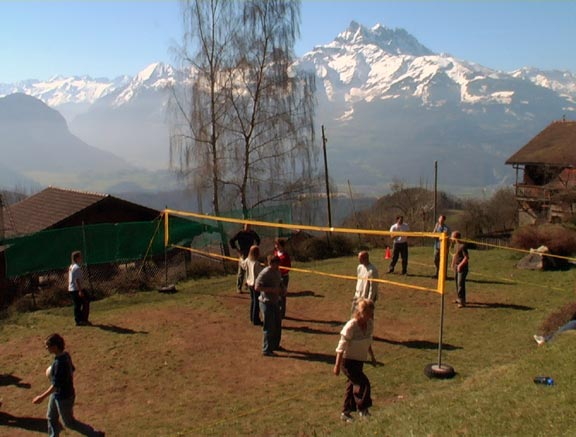 took the train from Geneva and am now enjoying a stay at L'abri in the little village of Huemoz. L'abri is a community founded by Francis and Edith Schaeffer for those looking to explore questions of faith, particularly in engagement with contemporary culture. Deanna and I were here back in 2003 when I delivered the lectures that have now become Who's Afraid of Postmodernism? (So it was a treat to bring copies of the book here for the L'abri library, in thanks for their hospitality.) I presented two lectures based on the new book I'm working on, tentatively called Desiring the Kingdom. Last night I enjoyed Richard and Karen Bradford's delicious fondue, and today I'm going to hike up to Villars before enjoying a formal lunch discussion with students this afternoon. It's a treat waking up to the Alps in my window--I only wish Dee and the kids were here with me to enjoy it.
Tuesday, May 02, 2006
Grade Avoidance Behavior: Colbert on Bush
OK, this is surely a sign of my lack of will to really dive into the stack of papers I have to grade. But if you, too, are looking for a way to be slothful, treat yourself to Stephen Colbert's "roast" of George W. Bush at the White House Correspondents Dinner.
Friday, April 28, 2006
Remembering Azusa Street: Pentecostal Centenary
Krista Tippett and the good folks at Speaking of Faith have put together an excellent program on the Azusa Street revival, featuring the wisdom Mel Robeck, whose new book on the Azusa Street revival I've been enjoying since the Society for Pentecostal Studies conference back in March.
Along with the program (which can be listened to online or downloaded as a podcast), the SoF site includes a wealth of resources related to global Pentecostalism. Great stuff.
Along with the program (which can be listened to online or downloaded as a podcast), the SoF site includes a wealth of resources related to global Pentecostalism. Great stuff.
Sunday, April 23, 2006
Kuyper and DeVos: If this is "transformation"...
My recent piece on Neocalvinism in Comment received some criticism either because (1) I suggested links between what now passes for Neocalvinism and the right-wing, libertarian elements of the Republican party, or (2) because I think that's a bad thing.
In that light, I find two recent local events almost laughable--if they weren't also disheartening. First, just a few days ago it was announced that what was formerly "Reformed Bible College" would henceforth be known as Kuyper College. Two days later it was announced that the very first commencement speaker for Kuyper College would be none other than Richard DeVos--co-founder of Amway (now Alticor), author of Compassionate Capitalism, and all-around symbol of the so-called "Reformed" tradition's baptism of Republican libertarian economics and war-mongering foreign policy.
Every square inch?
In that light, I find two recent local events almost laughable--if they weren't also disheartening. First, just a few days ago it was announced that what was formerly "Reformed Bible College" would henceforth be known as Kuyper College. Two days later it was announced that the very first commencement speaker for Kuyper College would be none other than Richard DeVos--co-founder of Amway (now Alticor), author of Compassionate Capitalism, and all-around symbol of the so-called "Reformed" tradition's baptism of Republican libertarian economics and war-mongering foreign policy.
Every square inch?
Thursday, April 13, 2006
Is there a box marked "other?"
My recent article on Neocalvinism in Comment generated some curious comments and reaction (both at the site and via email). Most of it is not worth a reply, but I continue to be amazed by a lack of imagination on the right which thinks that a criticism of the Bush administration can only mean that someone loves all things Clintonian and Democratic. In other words, they seem to imagine that someone who criticizes “the Right” must be a card-carrying member of “the Left” (as if there was one). One would hope for a little more nuance. So I was surprised to see myself being dismissed as yet another “liberal.” I think I’ve pretty clearly indicated—in my critique of Jim Wallis and in my sympathy for Hitchens’ lambasting of the Clintons—that I’m no friend of the left. Instead, I find myself in deep sympathy with Ruskin who, in the very first letter of Fors Clavigera, trying to subvert such simplistic dichotomies:
“Consider, for instance, the ridiculousness of the division of parties into ‘Liberal’ and ‘Conservative.’ There is no opposition whatever between these two kinds of men. There is opposition between Liberals and Illiberals; that is to say, between people who desire liberty, and who dislike it. I am a violent Illiberal; but it does not follow that I must be a Conservative.”
Wednesday, March 15, 2006
The EQ Test: How Evangelical Are You?
I've always secretly enjoyed a genre of humorous, "takes-one-to-know-one," accounts of evangelical Christianity, such as Patricia Klein's Just As We Were, or Sweeney's memoir, Born Again and Again: Surprising Gifts of a Fundamentalist Childhood. So I'm intrigued by the new offering from Joel Kilpatrick's A Field Guide to Evangelicals and Their Habitat. Kilpatrick's is a slight departure from the genre, it seems, insofar as the book is written more for "outsiders," but it clearly displays "insider" knowledge. But this is also a departure insofar as it's less charitable than Klein or Sweeney: the tone seems to be more along the line of The Simpsons' Guide to Evangelicalism. Nevertheless, sure to be entertaining.
For a taste, visit the "EQ Test" on the book's website, designed to help you discern "how evangelical" you are. Classic cases of evangelical shibboleths.
For a taste, visit the "EQ Test" on the book's website, designed to help you discern "how evangelical" you are. Classic cases of evangelical shibboleths.
Friday, March 10, 2006
Bush and Blair's Secular Religion
Philip Blond and Adrian Pabst, two bright young British theologians, today published an insightful commentary on "The Twisted Religion of Blair and Bush" in the International Herald Tribune (roughly an arm of the NYT in Europe, for those not familiar). A fine example of thoughtful, accessible theologically-informed public commentary.
Friday, March 03, 2006
I'm Not Kidding
Left Behind: The Video Game
Yet one more piece of evidence confirming the Babylonian captivity of American evangelicalism.
Yet one more piece of evidence confirming the Babylonian captivity of American evangelicalism.
Sunday, February 12, 2006
Evangelicals and Climate: Update
The Evangelical Climate Initiative can now be found online (including in .pdf), including the list of signatories. I was very encouraged to see that the President of my home institution signed on. The list of signatories is worth a look. Let's hope this might be the beginning of an erosion of the Colorado Springs consensus.
Wednesday, February 08, 2006
Evangelical Cliimate Initiative
I had been pretty disheartened last Saturday by Washington Post story noting that the National Association of Evangelicals would not issue a statement regarding global warming ("climate change" in newspeak). The NAE's initiative on this was basically derailed by the usual unholy trinity of James Dobson, Chuck Colson, and Richard Land (Al Moehler must have been unavailable for comment).
However, today some more encouraging news: the NYT reports on a 'renegade' group of evangelicals issuing a statement on their own. Unfortunately I've not yet been able to locate a copy of the "Evangelical Climate Initiative," but I'm eager to see the list of endorsers.
[Posting this from a fabulous visit to Seattle, lecturing at Northwest University. Deanna has been able to make the trip with me due to the support of wonderful friends. Today we head up to Vancouver for some more lectures at Regent College.]
However, today some more encouraging news: the NYT reports on a 'renegade' group of evangelicals issuing a statement on their own. Unfortunately I've not yet been able to locate a copy of the "Evangelical Climate Initiative," but I'm eager to see the list of endorsers.
[Posting this from a fabulous visit to Seattle, lecturing at Northwest University. Deanna has been able to make the trip with me due to the support of wonderful friends. Today we head up to Vancouver for some more lectures at Regent College.]
Wednesday, January 25, 2006
God is Love: Benedict XVI's First Encyclical
The New York Times is, unsurprisingly, "surprised" that Benedict XVI's first encyclical (Deus caritas est) would be concerned with love. Their surprise is due to the fact that they'd bought the story of Ratzinger the Inquisitor rather than engaging the history of his work.
I've not yet had a chance to read the encyclical closely (assigning it in my "Urban Altruism" seminar this spring will provide an opportunity), but a quick skim indicates that what's really at stake here are questions about the relationship between church and "state," and just which entity is responsible for the formation of a "just" society. (That a discussion of love would entail a discussion of justice is the sort of link that liberalism couldn't think.) In this regard, Benedict follows a pretty straightforward line regarding subsidiarity--a line which, I think, could be justly questioned. Nevertheless, this is an important document that the entire global church--and even states--ought to engage. One could hope it will stimulate important conversations on these matters.
I've not yet had a chance to read the encyclical closely (assigning it in my "Urban Altruism" seminar this spring will provide an opportunity), but a quick skim indicates that what's really at stake here are questions about the relationship between church and "state," and just which entity is responsible for the formation of a "just" society. (That a discussion of love would entail a discussion of justice is the sort of link that liberalism couldn't think.) In this regard, Benedict follows a pretty straightforward line regarding subsidiarity--a line which, I think, could be justly questioned. Nevertheless, this is an important document that the entire global church--and even states--ought to engage. One could hope it will stimulate important conversations on these matters.
Monday, January 23, 2006
Canadian Election Today
You wouldn't know it from most mainstream American media coverage (the BBC highlights it more), but today Canadians go to the polls in a federal parliamentary election. The Globe & Mail is projecting a minority government for the Conservative Party. The challenge for the conservatives is finding anyone to play coalition government with. This could be a very short-lived government.
It's at least interesting to note that as Latin American elections have quite steadily swung to the left, North American electorates are swinging to the right (though the "right" in Canada still makes American Democrats look like Thatcherites on some issues). However, there is an interesting subplot to this Canadian election, too, as the NDP seem to be gaining ground (as well as the Bloc Quebecois, which is also left-of-center). We'll see...
It's at least interesting to note that as Latin American elections have quite steadily swung to the left, North American electorates are swinging to the right (though the "right" in Canada still makes American Democrats look like Thatcherites on some issues). However, there is an interesting subplot to this Canadian election, too, as the NDP seem to be gaining ground (as well as the Bloc Quebecois, which is also left-of-center). We'll see...
Monday, January 16, 2006
Christian Scholars, Public Intellectuals, and the Challenges of Finitude
I’ve found myself bumping up against my finitude quite a lot in the past month, which has got me to thinking some about the unique challenges for Christian scholars who want to also try to play the role of public intellectuals. (Gideon Strauss’s recent Comment article on the New York intellectuals furthered my thinking on this score.)
Perhaps some prefatory words about “public intellectuals” are in order. By a “public intellectual,” I mean someone who brings critical, analytic, and synthetic theoretical skills to bear on issues of public concern—and then is able to articulate and express both a critique and vision in ways that are provocative, winsome, insightful, and—one hopes—persuasive. Many public intellectuals are credentialed scholars who feel impelled—as a matter of public trust—to take their skills and expertise outside the narrow (but legitimate) discussions of the academy. (A host of examples here, but a few that come to mind: Cornel West, Noam Chomsky, Richard Dawkins—not to mention a whole host of French thinkers from Sartre to Derrida to Luc Ferry.) But two provisos are in order here: First, not all scholars are, or are called to be, public intellectuals. And I don’t mean to suggest that scholars who stay within the confines of academic discourse are somehow failing in their vocation. The world of scholarly investigation and conversation is a legitimate end in itself and need not be justified only by “application” to public issues. That would be to fall into the worst sort of pragmatism. Second, not all public intellectuals are (or need be) credentialed scholars. Someone like Christopher Hitchens immediately comes to mind. A brilliant, critical mind emerging from Oxford, Hitchens does not have a PhD. But that hardly undercuts his ability to fulfill the role I’ve sketched above.
Now, with that in mind, I think there is a unique set of challenges for the Christian scholar who would seek to be a public intellectual. Let me enumerate just three as a start:
1. The Christian scholar who senses a vocation as a public intellectual immediately runs up against a challenge that I would think does not confront a “secular” public intellectual: guilt. Perhaps this is the result of my Calvinism working overtime, but I think it is a phenomenon that was glimpsed powerfully by Augustine in Book X of the Confessions. I need to ask myself just why I want to be a public intellectual. Is it just for the (relative) “fame?” Augustine’s reflection on this challenge is, for me, one of the most haunting passages of the Confessions. Extending his reflection on the temptations outlined in 1 John 2:16 (the lust of the flesh, the lust of the eyes, and worldly ambition), Augustine lands on the third as the one that continues to plague him most: “Surely the third kind of temptation has not ceased to trouble me, nor during the whole of this life can it cease. The temptation is to wish to be feared or loved by people for no reason other than the joy derived from such power.” (Conf. 10.36.59). In fact, upon becoming a bishop, the temptation only increased such that Augustine the bishop could confess: “This is [not “was”] the main cause why I fail to love you.” And I have to confess the same.
And so, unlike other public intellectuals who aren’t beset by this Augustinian self-suspicion, the Christian who would become a public intellectual and who is really honest with himself or herself must run up against this kind of lust for fame operative in one’s soul. That first whiff of public acclaim is an intoxicating drug. But Augustine also recognizes the complexity and messiness of all this, for he clearly counsels that the solution is not a withdrawal from acting for the public good. For indeed, even the one acting as a public intellectual (and surely a bishop was a public intellectual) with the purest of motives will nevertheless find himself the subject of praise and acclamation. Should Augustine abandon doing his public labors well just so that he’s not tempted by fame and the praise of men? By no means, he concludes. This would be akin to think the way to avoid gluttony is to avoid eating. Rather, the good work of a public intellectual should be accompanied by a rigorous self-examination—and real honesty about how easy it is to get hooked on the drug of “public interest.”
2. There is a second unique challenge for Christian public intellectuals, I think: a matter of time, and particularly finitude. Being a public intellectual requires an almost tiring attentiveness to “the signs of the times” and to what’s happening. A public intellectual is almost by nature a reactive beast, responding to the contingencies of always unfolding cultures. And to put the point bluntly: this just requires a lot of time. The day begins by scouring the dailies (The New York Times, and maybe the LA Times and Washington Post; perhaps The Guardian, The Globe & Mail, Le Monde and the BBC for international perspectives). On top of this is the responsibility of keeping up with the monthlies (The Atlantic, Harper’s, New York Review of Books, etc.) and quarterlies (Wilson Quarterly, New Left Review, New Criterion, etc.). Add to this the responsibility of actually reading books, both new non-fiction and fiction (and, in my case, trying to make up for the lack of a liberal arts education by working one’s way through the “classics”—I’m currently in a Proust phase).
And then there’s the challenge—in the midst of all this reading—of finding time to actually write. If one retains an academic post which requires straight-up “scholarly” publication, then writing in the mode of a public intellectual happens in the margins and off the side of one’s desk. And such writing, because of its occasional nature, must often be done quickly.
Now, that in itself is quite a full-plate for anyone (particularly since I haven’t even mentioned the other realities and obligations that are “givens”—especially family). But this is also where the unique challenge for a Christian public intellectual sets in, in at least a couple of ways.
First, when it comes to keeping abreast of what’s happening, the Christian public intellectual has another entire world to monitor and understand, which translates into another complete set of alternative readings responsibilities. So beyond keeping up with the readings noted above, the Christian public intellectual is also reading the Christian Century, Books & Culture, Christianity Today, First Things, Commonweal, etc. There is another world to keep up on—a sort of parallel universe about which someone like Christopher Hitchens doesn’t have to bother. (Though, one could admit that we live in strange times, when the worlds of Vanity Fair and Jerry Falwell have come to overlap!) All of this reading takes time, which is dispensed in only finite allotments.
Second, the Christian public intellectual has another set of commitments that fills up the slate of time. In particular, I’m thinking of the very banal reality that, for the Christian public intellectual, Sunday mornings are pretty much shot (not, of course, on an eternal register, but you get the idea). I confess to having a certain envy for my secular friends who enjoy leisurely Sunday mornings on the upper westside, slowly ambling through the Sunday Times, maybe catching up on a Harper’s article, or curling up with a Wilde play or Rushdie’s latest novel. Sunday mornings, of course, are just the tip of the iceberg, since many of those who sense a burden and vocation as Christian public intellectuals also have a sense of service to the church, and thus are often involved in time intensive labors related to the ministry of the church. (Granted, this isn’t true for all; in fact some “Christian” intellectuals solve this problem by abandoning the church!)
3. Finally, I think the Christian public intellectual is burdened by a multiplication of publics. The “public” for the ‘secular’ public intellectual is relatively defined, though there might be varying levels (from smaller ‘highbrow’ publics to broader ‘middle-brow’ publics). The “public” here just represents those readers of the canonical periodicals and monthlies. But here again, the work of the Christian public intellectual is doubled, since the church represents its own public, with its own institutions (e.g., its own canonical periodicals and monthlies, etc). And this public is much more variegated and diverse, particularly with respect to education levels, political orientations, and general configuration of “what matters.” So the Christian public intellectual needs to have the flexibility of a gymnast and the agility of an acrobat—as well as the stamina of Hidalgo just to keep up the work!
I don’t mean this piece to sound like whining (no doubt it does). Rather, I mean only to say that I have the utmost respect for the labors of our public intellectuals, and that respect is doubled for Christian public intellectuals (Cornel West, George Weigel, etc.) who are able to manage all of these challenges without sacrificing what really matters.
Perhaps some prefatory words about “public intellectuals” are in order. By a “public intellectual,” I mean someone who brings critical, analytic, and synthetic theoretical skills to bear on issues of public concern—and then is able to articulate and express both a critique and vision in ways that are provocative, winsome, insightful, and—one hopes—persuasive. Many public intellectuals are credentialed scholars who feel impelled—as a matter of public trust—to take their skills and expertise outside the narrow (but legitimate) discussions of the academy. (A host of examples here, but a few that come to mind: Cornel West, Noam Chomsky, Richard Dawkins—not to mention a whole host of French thinkers from Sartre to Derrida to Luc Ferry.) But two provisos are in order here: First, not all scholars are, or are called to be, public intellectuals. And I don’t mean to suggest that scholars who stay within the confines of academic discourse are somehow failing in their vocation. The world of scholarly investigation and conversation is a legitimate end in itself and need not be justified only by “application” to public issues. That would be to fall into the worst sort of pragmatism. Second, not all public intellectuals are (or need be) credentialed scholars. Someone like Christopher Hitchens immediately comes to mind. A brilliant, critical mind emerging from Oxford, Hitchens does not have a PhD. But that hardly undercuts his ability to fulfill the role I’ve sketched above.
Now, with that in mind, I think there is a unique set of challenges for the Christian scholar who would seek to be a public intellectual. Let me enumerate just three as a start:
1. The Christian scholar who senses a vocation as a public intellectual immediately runs up against a challenge that I would think does not confront a “secular” public intellectual: guilt. Perhaps this is the result of my Calvinism working overtime, but I think it is a phenomenon that was glimpsed powerfully by Augustine in Book X of the Confessions. I need to ask myself just why I want to be a public intellectual. Is it just for the (relative) “fame?” Augustine’s reflection on this challenge is, for me, one of the most haunting passages of the Confessions. Extending his reflection on the temptations outlined in 1 John 2:16 (the lust of the flesh, the lust of the eyes, and worldly ambition), Augustine lands on the third as the one that continues to plague him most: “Surely the third kind of temptation has not ceased to trouble me, nor during the whole of this life can it cease. The temptation is to wish to be feared or loved by people for no reason other than the joy derived from such power.” (Conf. 10.36.59). In fact, upon becoming a bishop, the temptation only increased such that Augustine the bishop could confess: “This is [not “was”] the main cause why I fail to love you.” And I have to confess the same.
And so, unlike other public intellectuals who aren’t beset by this Augustinian self-suspicion, the Christian who would become a public intellectual and who is really honest with himself or herself must run up against this kind of lust for fame operative in one’s soul. That first whiff of public acclaim is an intoxicating drug. But Augustine also recognizes the complexity and messiness of all this, for he clearly counsels that the solution is not a withdrawal from acting for the public good. For indeed, even the one acting as a public intellectual (and surely a bishop was a public intellectual) with the purest of motives will nevertheless find himself the subject of praise and acclamation. Should Augustine abandon doing his public labors well just so that he’s not tempted by fame and the praise of men? By no means, he concludes. This would be akin to think the way to avoid gluttony is to avoid eating. Rather, the good work of a public intellectual should be accompanied by a rigorous self-examination—and real honesty about how easy it is to get hooked on the drug of “public interest.”
2. There is a second unique challenge for Christian public intellectuals, I think: a matter of time, and particularly finitude. Being a public intellectual requires an almost tiring attentiveness to “the signs of the times” and to what’s happening. A public intellectual is almost by nature a reactive beast, responding to the contingencies of always unfolding cultures. And to put the point bluntly: this just requires a lot of time. The day begins by scouring the dailies (The New York Times, and maybe the LA Times and Washington Post; perhaps The Guardian, The Globe & Mail, Le Monde and the BBC for international perspectives). On top of this is the responsibility of keeping up with the monthlies (The Atlantic, Harper’s, New York Review of Books, etc.) and quarterlies (Wilson Quarterly, New Left Review, New Criterion, etc.). Add to this the responsibility of actually reading books, both new non-fiction and fiction (and, in my case, trying to make up for the lack of a liberal arts education by working one’s way through the “classics”—I’m currently in a Proust phase).
And then there’s the challenge—in the midst of all this reading—of finding time to actually write. If one retains an academic post which requires straight-up “scholarly” publication, then writing in the mode of a public intellectual happens in the margins and off the side of one’s desk. And such writing, because of its occasional nature, must often be done quickly.
Now, that in itself is quite a full-plate for anyone (particularly since I haven’t even mentioned the other realities and obligations that are “givens”—especially family). But this is also where the unique challenge for a Christian public intellectual sets in, in at least a couple of ways.
First, when it comes to keeping abreast of what’s happening, the Christian public intellectual has another entire world to monitor and understand, which translates into another complete set of alternative readings responsibilities. So beyond keeping up with the readings noted above, the Christian public intellectual is also reading the Christian Century, Books & Culture, Christianity Today, First Things, Commonweal, etc. There is another world to keep up on—a sort of parallel universe about which someone like Christopher Hitchens doesn’t have to bother. (Though, one could admit that we live in strange times, when the worlds of Vanity Fair and Jerry Falwell have come to overlap!) All of this reading takes time, which is dispensed in only finite allotments.
Second, the Christian public intellectual has another set of commitments that fills up the slate of time. In particular, I’m thinking of the very banal reality that, for the Christian public intellectual, Sunday mornings are pretty much shot (not, of course, on an eternal register, but you get the idea). I confess to having a certain envy for my secular friends who enjoy leisurely Sunday mornings on the upper westside, slowly ambling through the Sunday Times, maybe catching up on a Harper’s article, or curling up with a Wilde play or Rushdie’s latest novel. Sunday mornings, of course, are just the tip of the iceberg, since many of those who sense a burden and vocation as Christian public intellectuals also have a sense of service to the church, and thus are often involved in time intensive labors related to the ministry of the church. (Granted, this isn’t true for all; in fact some “Christian” intellectuals solve this problem by abandoning the church!)
3. Finally, I think the Christian public intellectual is burdened by a multiplication of publics. The “public” for the ‘secular’ public intellectual is relatively defined, though there might be varying levels (from smaller ‘highbrow’ publics to broader ‘middle-brow’ publics). The “public” here just represents those readers of the canonical periodicals and monthlies. But here again, the work of the Christian public intellectual is doubled, since the church represents its own public, with its own institutions (e.g., its own canonical periodicals and monthlies, etc). And this public is much more variegated and diverse, particularly with respect to education levels, political orientations, and general configuration of “what matters.” So the Christian public intellectual needs to have the flexibility of a gymnast and the agility of an acrobat—as well as the stamina of Hidalgo just to keep up the work!
I don’t mean this piece to sound like whining (no doubt it does). Rather, I mean only to say that I have the utmost respect for the labors of our public intellectuals, and that respect is doubled for Christian public intellectuals (Cornel West, George Weigel, etc.) who are able to manage all of these challenges without sacrificing what really matters.
Subscribe to:
Posts (Atom)